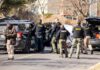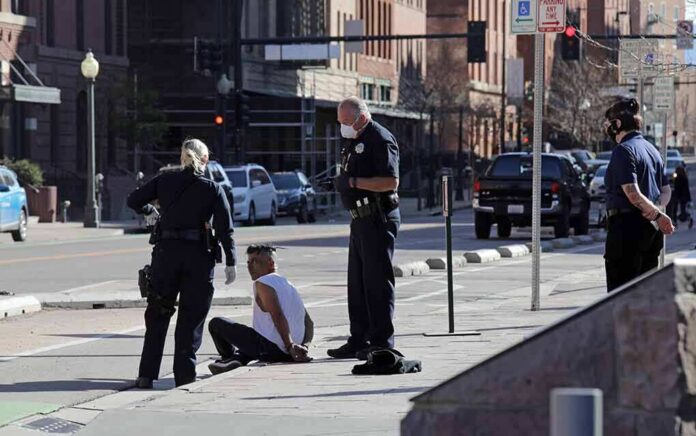
A wheelchair user was set on fire outside Oklahoma City Police headquarters, and police say the suspect was arrested at the scene.
Quick Take
- Police say Alexander James Emery threw a Molotov cocktail at a man in a wheelchair and was arrested right away.
- Video released by police shows the attack happening across from Oklahoma City Police headquarters.
- Local reports say the victim suffered minor injuries and was expected to recover.
- The public record still leaves some gaps, including the full police interview and formal medical report.
What the Video Shows
Police and news video show a fast and violent attack in downtown Oklahoma City. The footage places the incident outside Oklahoma City Police Department headquarters and shows the suspect approaching the victim, throwing a Molotov cocktail, and pushing him back into the flames. NBC News and other outlets reported the scene as caught on camera, which gave the case immediate national attention.
The attack is disturbing not only because of the fire, but because of where it happened. An assault in front of police headquarters raises obvious questions about security and how quickly danger can unfold in a public space. It also adds to a broader concern shared by many Americans: public institutions often look powerful until a crisis exposes how exposed people still are.
Arrest, Charges, and the Suspect’s Statement
Police say Emery was arrested at the scene and now faces multiple felony charges, including assault with intent to kill and assault and battery with a deadly weapon. Reports based on the police account say he was also found with a second Molotov cocktail, which suggests planning rather than a split-second act. One local broadcast reported that Emery said he acted “at random” and “just felt like doing it.”
That detail matters because it shapes how the public reads the case. If the reported statement is accurate, the attack was not tied to a dispute between the two men. Instead, it appears to have been a random strike against a disabled stranger. That is why the case has drawn such anger, especially from people who already feel that basic safety in American cities is getting harder to trust.
Injury, Response, and Public Gaps
Available reports say the victim suffered minor injuries despite the severity of the attack. Bystanders and officers helped pull him away and get him care, which likely prevented a worse outcome. The quick response is one reason the victim survived an attack that could have turned fatal in seconds. It also shows how much depended on immediate help from ordinary people, not just the system meant to protect them.
WATCH: Video Shows Man in Wheelchair Set on Fire by Molotov Cocktail Wielding Attacker Outside Oklahoma City Police Headquarters * The Gateway Pundit * by Jordan Conradson https://t.co/txn9Vw1eV7
— PiperNadorff (@PiperNadorff) July 9, 2026
Still, the public record is incomplete. The full interrogation transcript has not been released, and the exact medical report has not been made public. There is also no independent forensic analysis of the device in the material provided. Those gaps do not weaken the core video evidence, but they do limit how fully outsiders can test the police version of events. In a case this serious, that missing detail will matter.
Why This Case Resonates
This attack fits a wider national concern about violence against people with disabilities. Federal research shows that people with disabilities face higher rates of violent victimization than people without disabilities, and people with cognitive disabilities face the highest rates among disability groups measured. That broader pattern gives this case more weight than a single shocking video. For many readers, it is another sign that some Americans remain easy targets in public life.
The case also touches a deeper frustration on both the left and the right. Many Americans see weak public safety, slow government response, and a system that feels more reactive than protective. When violence happens in front of police headquarters, those doubts grow stronger. The facts here are specific, but the reaction is national because the story speaks to something larger: a country still struggling to protect the vulnerable in plain sight.
Sources:
thegatewaypundit.com, instagram.com, facebook.com, yahoo.com, vera.org