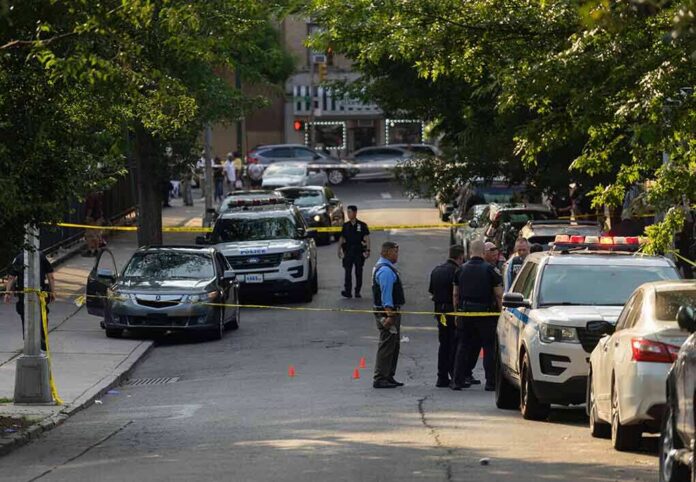
A Monaco bomb case that drew global attention has now turned into a murder probe, after Ukrainian authorities said the suspect was found shot dead near Kyiv.
Quick Take
- Ukrainian authorities say Anastasiia Berezovska was wanted in the Monaco bombing case and was later found dead in Ukraine.
- The Security Service of Ukraine said her body had gunshot wounds to the head near Kyiv.
- Two men were arrested in connection with her death, including a Defense Ministry official and a former law enforcement officer.
- The case raises fresh questions about how quickly a foreign bombing probe can turn into a separate killing investigation.
From bombing suspect to murder victim
Interpol’s Red Notice identified Berezovska as a suspect in attempted murder, explosive-device placement, and criminal conspiracy in Monaco, according to Ukrainian prosecutors. That notice came after reporting that Monaco investigators linked the attack to a Ukrainian woman who allegedly disguised herself as a man. The case centers on a June 29 blast that injured Ukrainian businessman Vadim Ermolaev and his family, then shifted sharply when prosecutors said the suspect returned to Ukraine on July 1.
By July 7, the story had changed again. The Security Service of Ukraine said Berezovska’s body was found near Kyiv with gunshot wounds to the head, and BBC News reported that two suspects had been arrested in her killing. One of them was described as a current official in Ukraine’s Ministry of Defence, while the other was a former law enforcement officer. Ukrainian investigators also said one suspect admitted involvement, which gives the case a new and much darker layer.
What the authorities say happened
The public account now rests on two separate sets of claims. First, Monaco and Ukrainian authorities say Berezovska was the woman tied to the bomb attack, and Interpol’s notice shows the formal charges investigators were pursuing. Second, Ukrainian security officials say her death led them to arrest two men, including the defense official, after a murder investigation opened near Kyiv. Reuters also reported that the body was found shot in the head, matching the official Ukrainian account.
The details remain uneven. Reporters said investigators traced cryptocurrency payments from the two arrested men to Berezovska’s account, suggesting a financial link between them. But the public record shared so far does not include the full forensic file, the confession transcript, or a court ruling on the murder case. That leaves room for caution about what has been proven and what has only been asserted by investigators during a fast-moving case.
Why the case draws wider attention
The case lands in a climate where official claims in conflict-linked crimes often spread faster than hard proof. Research on violence and disinformation shows that false claims can spread quickly in tense environments, especially when events carry political meaning. It also shows that covert attacks are often hard to verify in real time, which can leave the public relying on government statements before full evidence is available. That is one reason this story has drawn both interest and skepticism.
For readers, the larger issue is not only who killed Berezovska, but how the story was built. The Monaco bombing case now includes an Interpol notice, a reported confession, a disputed chain of crypto payments, and a second killing near Kyiv. Each piece may matter, but each also needs hard proof before it can stand as final truth. In a region shaped by war, elite power struggles, and public distrust, that gap between claim and proof matters as much as the crime itself.
Sources:
thegatewaypundit.com, abc.net.au, bbc.co.uk, news.sky.com, isdglobal.org, pure.psu.edu