Skylab’s story is the archetype of high-stakes engineering in space: a 77‑ton station nearly lost on launch, pulled back from the brink by an improvised sunshade and on-orbit repairs, then sent back to Earth in a controlled fall that scattered debris across Western Australia — and earned NASA a symbolic littering fine.
Key Points
- Skylab, launched in 1973, was the United States’ first space station and weighed roughly 77 tons.
- Launch damage tore off its micrometeoroid/thermal shield and crippled its main solar arrays, leaving the station dangerously hot and underpowered.
- Engineers devised an improvised “parasol” sunshade and the first large-scale repair spacewalk, enabling astronauts to stabilize Skylab and complete three successful crewed missions.
- Skylab reentered the atmosphere on July 11, 1979, with debris landing in Western Australia; the shire of Esperance famously issued NASA a $400 fine for littering.
Skylab: America’s First Space Station and Its Ambitious Design
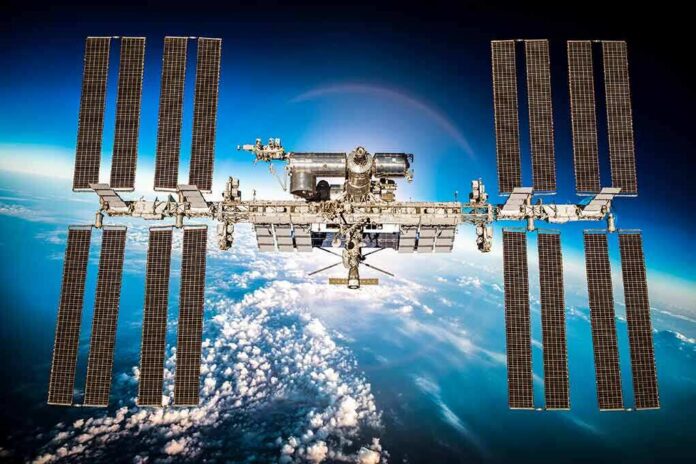
By the early 1970s, the United States had flown astronauts to the Moon but had not yet operated a long-duration orbital outpost. In response to the Soviet Salyut program, NASA developed Skylab, a space station built largely from the converted upper stage of a Saturn rocket. Launched unmanned on May 14, 1973, atop the final Saturn V, Skylab massed roughly 77 tons and provided over 12,000 cubic feet of habitable volume — enough space for a workshop, living quarters, and a dedicated solar observatory. The design relied on extensive solar power and a combination micrometeoroid shield and thermal blanket to keep internal temperatures within safe limits, reflecting the classic systems-engineering balance between structural integrity, power generation, and thermal control that underpins any complex spacecraft.
Skylab’s configuration embodied a straightforward mission logic: use proven Apollo hardware to gain rapid, relatively inexpensive access to an orbital laboratory. The station’s orbital workshop housed experiments on human physiology, materials science, and Earth observation; the Apollo Telescope Mount carried instruments for studying the Sun at multiple wavelengths. What was less fully appreciated before launch was the vulnerability of this repurposed hardware to the violent aerothermal environment of ascent, particularly the way aerodynamic loads could interact with appendages designed primarily for deployment in orbit rather than survival through supersonic flight.
A Near-Disaster at Launch: Losing the Shield and Solar Power
Trouble began just over a minute after liftoff. NASA telemetry showed that at about 63 seconds into flight, Skylab’s micrometeoroid shield — which also served as a thermal shield — deployed prematurely, at a point when aerodynamic forces were still severe. Those forces ripped the shield away from the orbital workshop. As the shield tore free, fragments entangled one of the two main lateral solar array wings, jamming it against the station’s hull, while the other wing was later torn off entirely by rocket exhaust during second-stage separation.
The result was a double crisis. Without its thermal shield, Skylab began to overheat; internal temperatures climbed toward levels that threatened food, film, plastics, and electronics. At the same time, the loss of one main array and the jamming of the other left the station with a fraction of the planned electrical power — telemetry indicated only tens of watts flowing from surviving sources, far short of what a crewed space station required. NASA’s investigation board later linked the mishap to design oversights and inadequate testing of how the shield would behave in the launch environment rather than simply in the benign conditions of orbit. In essence, a component designed to protect the station in space had not been robust enough to survive the journey to get there.
Mission controllers briefly had to consider whether Skylab was a total loss. The station did reach orbit and separate from its Saturn booster, but with rising temperatures and crippled power systems, it was not a habitable outpost in any practical sense. Yet four small solar arrays on the Apollo Telescope Mount deployed as intended, yielding enough power to stabilize attitude and keep the station controllable from the ground while engineers worked the problem. That breathing room proved crucial; without it, there would have been no platform left to save.
Improvising a Parasol: Engineering a Thermal Lifeline
NASA’s response unfolded in classic systems-engineering fashion: understand the failure modes, triage the most critical risks, and design mitigations that could be tested on the ground and implemented in space with the hardware and crew capabilities available. The immediate threat was thermal; if Skylab overheated, consumables and equipment would be irreparably damaged long before astronauts arrived. Engineers therefore focused first on restoring thermal control, even before tackling full power recovery.
Jack Kinzler, head of the Technical Services Division at Johnson Space Center and known internally as “Mr. Fix It,” proposed a deceptively simple solution: an umbrella-like parasol that could be inserted through a small instrument port and then deployed externally to shade the damaged hull. The sunshade would not restore the original micrometeoroid shield, but it would cut direct solar heating enough to bring internal temperatures back into a survivable range. Built of woven nylon, Mylar, and aluminum, the parasol was designed under severe constraints of size, mass, and deployment geometry; the access port was roughly 20 centimeters square, and the crew would need to manipulate the device from inside a station they had never personally inspected.
Engineers rapidly prototyped, tested, and refined the parasol concept on the ground, then integrated it into the first crew’s procedures. When astronauts boarded Skylab during the Skylab 2 mission, they found an interior that was indeed hot but still recoverable. On their second day, working in searing conditions, they carefully fed the folded parasol through the port and extended it to cover the sunward side of the workshop. The effect was immediate: temperatures dropped toward normal operating values, halting further thermal degradation and stabilizing the environment for subsequent repairs. The parasol did not solve the power problem, but it removed the most time‑critical failure mode and proved that improvisation, when grounded in solid engineering, could buy crucial margins in space.
Repairing Skylab in Orbit: The First Major Space Station Fix
With thermal conditions improved, the next challenge was power. The jammed solar array wing still held significant energy potential, but it was pinned against the station by debris from the torn shield. Freeing it would require a dedicated spacewalk — and tools capable of cutting or prying metal in microgravity without destabilizing the station. NASA and its contractors devised specialized cutters, prybars, and a portable work platform to allow astronauts to work near the damaged wing.
During a complex extravehicular activity, astronauts maneuvered to the stuck array, removed the obstructing metal, and managed to free the wing, allowing it to deploy and begin generating power. Contemporary accounts from NASA describe this as the first-ever repair spacewalk focused on fixing a crippled spacecraft rather than simply assembling or servicing planned hardware. In combination with the parasol, the restored array transformed Skylab from a wounded hulk into a functioning station. Over three crewed missions totaling about 24 weeks of human occupancy, astronauts conducted solar physics research, Earth observations, and biomedical experiments that deepened understanding of long-duration spaceflight.
From a technical standpoint, Skylab’s rescue illustrated several enduring truths. First, launch remains the most hazardous phase for complex spacecraft; structures and appendages must be designed not only for their orbital function but for survival through extreme vibration and aerodynamic loads. Second, robust telemetry and analytical capability on the ground are as essential to mission success as hardware in orbit — without detailed data from the launch, engineers would not have understood the nature of Skylab’s damage or been able to craft targeted fixes. Third, design margins and subsystem redundancy, such as the separate solar arrays on the Apollo Telescope Mount, can keep a mission alive long enough for human ingenuity to matter.
Falling Back to Earth: Skylab’s 1979 Reentry Over Australia
Skylab’s operational life was always finite. The station orbited Earth in a regime where atmospheric drag, though weak, gradually lowers altitude. NASA originally hoped to reboost Skylab using the Space Shuttle, but delays in shuttle development and increased solar activity — which heated and expanded the upper atmosphere, increasing drag — brought the station down earlier than planned. After the final crewed mission in 1974, Skylab was left unmanned, with its orbit slowly decaying over the ensuing years.
By mid-1979, calculations showed that reentry was inevitable. NASA worked to minimize risk by using the station’s remaining attitude control and thrusters to target a largely oceanic footprint, aiming for the southern Pacific and Indian Ocean region. On July 11, 1979, Skylab reentered Earth’s atmosphere, broke up, and scattered debris across the southeastern Indian Ocean and parts of Western Australia. Despite early public anxiety — lotteries and media promotions invited people to “guess” where Skylab would land — no injuries were reported. The episode became a global media event, reflecting both fascination with space technology and unease about large objects falling uncontrolled from orbit.
One small Australian shire, Esperance, found itself unexpectedly in the spotlight. Debris fell near the town, and local authorities issued NASA a symbolic fine of $400 for littering, underscoring both the lighthearted and serious dimensions of space debris as a civic concern. The fine became part of Skylab folklore, a reminder that the consequences of orbital activity eventually reach the ground and intersect with everyday communities. In later decades, the international community would develop more formal guidelines and norms around end‑of‑life disposal for satellites and stations, but Skylab’s fall was an early, vivid case study in what uncontrolled reentry looks like from the perspective of those on the ground.
Skylab’s Legacy: Engineering Lessons and Cultural Memory
In retrospect, Skylab occupies a pivotal place in spaceflight history. Technically, it delivered the United States’ first sustained human presence in orbit and a rich set of scientific results, particularly in solar physics and human adaptation to weightlessness. Equally important, however, were the design and operations lessons extracted from both its near‑loss at launch and its ultimate reentry. The failure of the micrometeoroid shield prompted more rigorous consideration of how appendages and protective structures interact with launch loads; later stations and large spacecraft placed greater emphasis on testing for ascent conditions, not just orbital deployment. The successful parasol and repair spacewalk demonstrated that contingency planning should not be limited to pre-defined scenarios; crews and ground teams benefit from flexible tools and interfaces that can support creative, unplanned interventions.
Culturally, Skylab’s saga reinforced the narrative of spaceflight as a domain where disaster and triumph often sit side by side. The image of astronauts unfurling a makeshift sunshade to cool a crippled station, and of debris raining harmlessly over remote Australia years later, gave the public a vivid sense of both the fragility and resilience of human-made objects in space. That narrative, while sometimes simplified in popular retellings into a single heroic fix, rests on substantial documentation from NASA, museums, and contemporary reporting that confirms the core elements: serious launch damage, improvised engineering solutions, effective on-orbit repair, and an eventual uncontrolled but mostly benign reentry.
For modern engineers and policymakers, Skylab’s experience underscores the importance of thinking across the entire lifecycle of an orbital asset: from the physics of ascent and the realities of on-orbit repair to the ethical and regulatory dimensions of disposal and debris. It is a reminder that space stations are not static monuments; they are dynamic systems that must survive environments they traverse only once as well as those they inhabit for years. Skylab nearly did not survive that first environment. The fact that it did — and went on to advance science before finally falling back to Earth — is less a mythic rescue story than a case study in how disciplined engineering, informed improvisation, and human adaptability can keep complex systems working at the edge of what is technically possible.
Sources:
19fortyfive.com, nss.org, nytimes.com, rocketstem.org, nasa.gov, spectrum.ieee.org, space.com, airandspace.si.edu, cbc.ca, en.wikipedia.org