

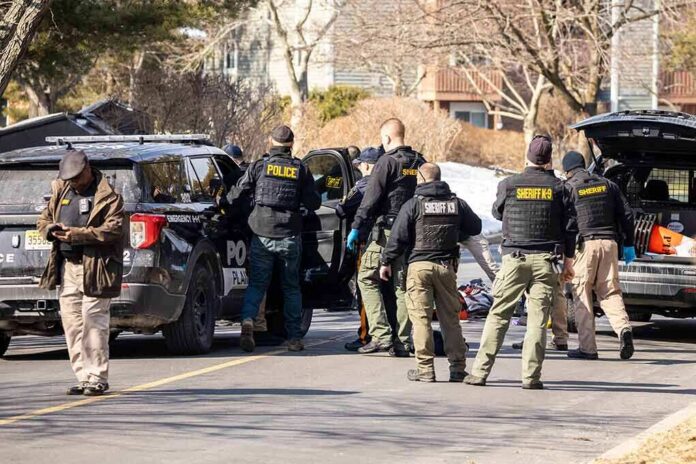
A deployed National Guard specialist was arrested in the nation’s capital for carrying a handgun without a local permit after a routine traffic stop led police to find the weapon.
Story Snapshot
- U.S. Park Police stopped a vehicle for an expired tag and found a handgun tied to a Guard member.
- Court records show he lacked a District of Columbia permit, triggering a felony charge.
- Strict District of Columbia gun rules differ sharply from many states, creating frequent confusion.
- Guard deployments in Washington have seen other firearm arrests, some later dropped.
What Police Say Happened During the Traffic Stop
U.S. Park Police stopped a vehicle in Washington on Monday for an expired registration tag. Officers said they saw an empty holster, asked about weapons, and then confirmed a handgun in the vehicle. Police arrested Specialist Jakob Noonan, 22, of the Oklahoma National Guard, and charged him with carrying a pistol without a license after learning he did not have a District of Columbia permit, according to Associated Press reporting and court records. Officials described the stop as a standard traffic enforcement action.
Associated Press accounts state Noonan was riding with another Guard member when the officer initiated the stop. Coverage across several outlets aligns on the core facts: a routine traffic stop, an observed holster, discovery of a handgun, and the lack of a local carry permit. Police booked Noonan on a felony count under District of Columbia law that requires a permit to carry a loaded handgun in a vehicle. Court records listed no valid District of Columbia concealed-carry license for him.
Why District of Columbia Gun Rules Trip Up Outsiders
District of Columbia law requires a person to have a District of Columbia-issued concealed-carry license to carry a loaded handgun in a vehicle. The city also requires firearm registration and sets specific duties if police stop a licensed carrier, including disclosure and presenting the license and registration. These rules are stricter than those in many states, including Oklahoma, creating risks for visitors who assume their home rules apply in the capital, according to city guidance and gun-law summaries.
District of Columbia’s rules limit where firearms may be carried, even for some law enforcement roles. The code restricts off-duty officers from carrying weapons in certain areas, including government property and parks. These limits reflect the city’s density, many federal sites, and security posture. The legal web can feel complex, but the key point is clear: local permits and compliance steps are mandatory inside the District, regardless of out-of-state status or military service.
Pattern: Guard Deployments and Firearm Friction in Washington
Recent deployments have put thousands of soldiers on Washington streets with limited law enforcement authority. Reports show that off-duty soldiers have been arrested more than once under the city’s firearm laws, and prosecutors later dropped some cases. This pattern suggests legal tension between strict local rules and service members’ expectations formed in other jurisdictions, even when missions aim to support public safety in the capital.
Separate from Noonan’s case, another Guard member faced a felony arrest after an alleged dispute involving a gun during a break from patrol, underscoring how fast routine moments can become criminal matters in this environment. These prior incidents do not change the core facts here. They do show why both supporters and critics worry: some see necessary enforcement in a high-risk city; others see rules that ensnare people serving the public.
What This Means for Troops, Police, and the Public
Commanders sending troops to Washington must brief them on the District’s carry, transport, and disclosure rules. Clear guidance can prevent arrests that stem from crossed wires on licensing or location limits. Park Police and city officers will keep enforcing the law as written, which centers on permits and registration. That places the burden on individuals—service members and civilians alike—to know the rules the moment they cross into District of Columbia limits.
National Guard soldier sent to Washington, DC, is arrested for carrying unlicensed firearm https://t.co/ECFFP9AHxJ
— つわもの (@chamono95741942) October 3, 2026
For many readers, this case taps a common frustration: overlapping rules, multiple jurisdictions, and the sense that institutions make simple things hard. It also highlights a shared concern across left and right. People want safety and clear standards, but they also want fair treatment for those doing tough jobs. The best fix is not a slogan. It is training, plain-language guidance, and consistent enforcement that treats everyone by the same rulebook, no matter their badge, branch, or home state.
Sources:
washingtontimes.com, kdhnews.com, bostonherald.com, pressdemocrat.com, dailynews.com, fox5dc.com, wn.com