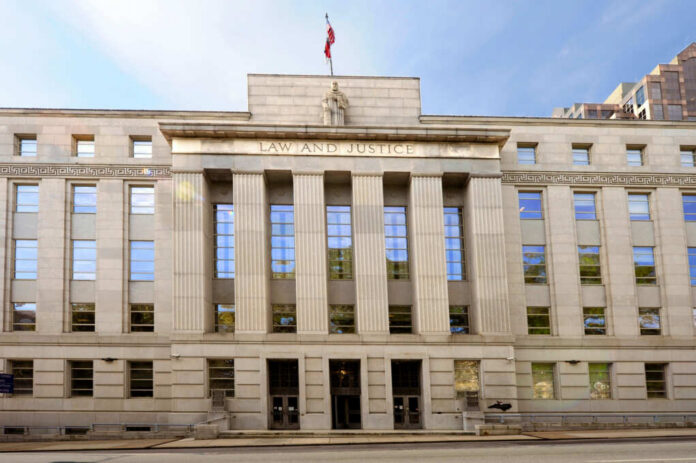
The Supreme Court’s latest geofence ruling is a sharp warning shot to police and tech firms that built a mass-tracking tool around vague lines on a map.
Quick Take
- The Court said geofence warrants count as a search under the Fourth Amendment.
- The ruling puts probable cause and particularity back at the center of location-data cases.
- The dispute turned on whether police can search first and identify suspects later.
- The case has become a test of how far digital privacy rights still reach.
What the Court Changed
The case, Chatrie v. United States, asked whether a warrant for location-history data triggers constitutional limits. The Court answered yes, according to the reporting in the research package, and that matters because a search normally must meet the Fourth Amendment’s rules on reasonableness, probable cause, and particularity [1][6]. In plain terms, police cannot rely on broad data grabs that sweep up many innocent people before narrowing the field.
The fight began with a robbery probe that led police to ask Google for location data tied to a defined area and time window. Supporters of the warrant said the data came from users who had already shared it with Google, so no search occurred. Privacy groups and the petitioner argued the opposite: the warrant let the government search every account inside the geofence, making it too broad and too close to a modern general warrant [2][3][5].
Why Privacy Advocates Call It a Big Deal
Privacy advocates say the ruling matters because location history can reveal a person’s home, work, doctor, church, and other sensitive places. The Brennan Center for Justice argued that geofence warrants let police travel backward through time and expose “the privacies of life” without targeting a specific suspect first [3]. That concern crosses party lines. Many conservatives see the case as a check on government overreach, while many liberals see it as a test of digital privacy in the age of constant tracking.
The deeper issue is simple: who controls the first move. If police can order a company to search a whole database and then decide whom to focus on later, the magistrate’s role becomes weaker. Cornell Law School’s summary notes that the government defended the warrant as supported by probable cause and enough detail, while Chatrie argued it was unconstitutionally broad because it covered every account in the radius [2]. That tension sits at the center of the case.
What It Means for Law Enforcement and Tech Companies
The ruling is likely to force more careful drafting of future warrants and more pushback on dragnet-style requests. National associations and legal groups warned that geofence warrants sit at the edge of what the Constitution allows, especially when they are aimed at unknown suspects and can sweep in large numbers of innocent users [5][6]. The practical result may be fewer easy data requests, more litigation, and more pressure on judges to draw clearer lines before data is turned over.
The decision also lands in a broader fight over the third-party doctrine, the old idea that people lose privacy protections when they share data with a company. Some justices and commentators have used that logic to argue that location history is less protected because users agreed to share it with Google [1][4]. But the opposing view, now strengthened by this ruling, is that modern phone data is too revealing to treat like ordinary business records. That is why this case drew so much attention.
BREAKING: In a landmark 6-3 decision, the Supreme Court rules that "geofence warrants," which allow law enforcement to collect sweeping smartphone location data over a broad area, constitute an "unreasonable search" and violate the Fourth Amendment.https://t.co/AuDXs9GLso
— David Spies (@davidspies) June 29, 2026
What comes next will likely matter as much as the ruling itself. Lower courts will still have to decide how much detail a geofence warrant needs, how narrow the time and space limits must be, and when good faith can still save evidence. The case shows how fast digital tools can outgrow old legal rules. It also shows why both sides of the privacy debate distrust institutions that collect too much data with too little restraint.
Sources:
[1] Web – In Big Win for Fourth Amendment Advocates, the Supreme Court Says …
[2] Web – In Chatrie v. United States, the Supreme Court Takes … – Venable LLP
[3] Web – Chatrie v. United States | Supreme Court Bulletin – Cornell Law School
[4] Web – Okello Chatrie v. United States of America – Brennan Center for …
[5] Web – Supreme Court Looks at Geofence Warrants in Chatrie
[6] Web – United States v. Chatrie – NACDL