

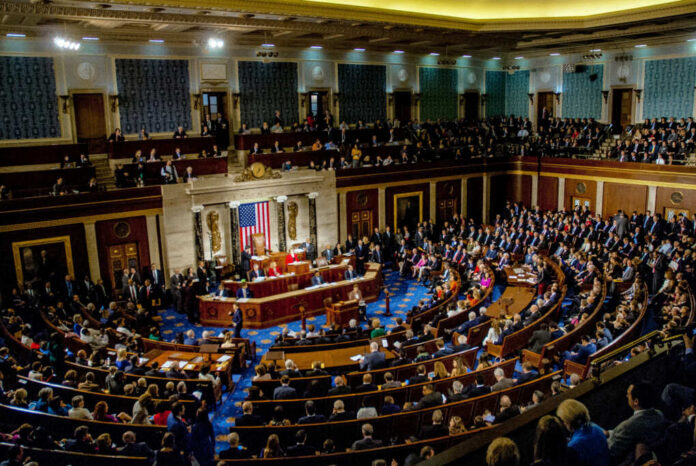
Almost half of House Democrats just voted to cut off billions in U.S. military aid to Israel, exposing a deep party rift that could reshape the midterms and fuel growing anger at Washington’s foreign‑policy elites.
Story Snapshot
- 103 House Democrats backed an amendment to end $3.3 billion in annual U.S. military aid to Israel, a near‑even split in the caucus.
- The amendment failed 314–104, but the size of the Democratic rebellion signals a major break from decades of near‑automatic, bipartisan support for Israel.
- Polls now show strong majorities of Democratic voters want military aid to Israel reduced or restricted over the Gaza war and Palestinian rights.
- The widening divide is reshaping 2026 primary fights, midterm messaging, and the clout of powerful pro‑Israel lobbying networks inside the party.
A landmark vote that exposed a deep Democratic split
On July 15, the House of Representatives voted on an amendment that would have cut off more than $3.3 billion in annual U.S. military aid to Israel by stripping that money from a State Department funding bill. The proposal came from Republican congressman Thomas Massie of Kentucky, a fiscal hawk who often opposes foreign aid across the board. The measure failed by a wide margin, with 314 lawmakers voting no and 104 voting yes. That outcome kept aid flowing for now.
The shock was not the defeat, but who supported the cut. Out of roughly 212 House Democrats, 103 voted for the amendment and 10 voted “present,” leaving only 98 Democrats clearly in favor of keeping full aid in place. Commentators described the near‑even split as “seismic,” because for most of the modern U.S.–Israel relationship, votes on aid were easy, bipartisan wins with only a handful of dissenters. Every Republican except Massie opposed the measure, underscoring how lopsided the divide has become between the two parties.
From quiet tension to open fight over Gaza and Netanyahu
The Democratic revolt did not appear overnight. Since Israel’s war in Gaza began in 2023, progressive Democrats have pressed harder for limits on weapons and accountability for civilian casualties. Many argue U.S. aid makes Americans complicit in policies they see as harsh, especially under Prime Minister Benjamin Netanyahu’s right‑leaning government. These members say voters in their districts are angry about images from Gaza and want Washington to stop sending “blank checks” overseas while problems at home grow worse.
More centrist Democrats and party leaders have tried to hold the old line: strong backing for Israel as a key security partner, paired with calls to reduce harm to civilians. Ahead of the vote, several top House Democrats publicly vowed to oppose the Massie amendment and urged colleagues to do the same. They warned that ending military aid outright could weaken Israel’s defenses, embolden hostile groups, and disrupt long‑standing U.S. strategy in the Middle East. Their stance reflected worries about both national security and backlash from influential pro‑Israel donors and advocacy groups.
Democratic voters are moving faster than their leaders
Recent polling suggests many Democratic elected officials are now lagging behind their own voters on Israel policy. A Washington Post–Ipsos survey found that nearly three‑quarters of Democrats want military support for Israel reduced or ended, and 40 percent want it completely eliminated. Separate surveys show a majority of Democrats view Israel negatively and believe the United States is too supportive of Israeli actions. These numbers would have been hard to imagine just a few years ago.
One poll from Data for Progress and Zeteo reported that 71 percent of likely Democratic primary voters want the United States to stop sending arms to Israel until it stops attacks on civilians in Gaza, supports Palestinian rights, and commits to a long‑term peace plan. Only about one‑fifth backed continued military aid under current conditions. Those figures help explain why progressive candidates now campaign openly on cutting or conditioning aid, and why some 2028 Democratic hopefuls are keeping their distance from powerful pro‑Israel groups they once courted.
Midterm stakes: primaries, lobby pressure, and distrust of elites
This fight over Israel aid is already shaping the 2026 midterm map. In many Democratic primaries, support for the U.S.–Israel alliance has become a litmus test that divides mainstream and progressive wings of the party. Progressive challengers argue that party insiders are too close to foreign‑policy elites and lobbyists, and too slow to respond to grassroots anger over Gaza. Incumbents in swing districts, meanwhile, fear that breaking with Israel could trigger heavy outside spending to defeat them.
More than 100 US House Democrats voted this week to cut military aid to Israel, exposing a widening party divide that could reshape both November's midterm elections and the future of one of Washington's most durable foreign policy alliances. https://t.co/JPR3PpXahc
— ANews (@anews) July 17, 2026
For voters on both the left and right who believe Washington is run for the benefit of a small “deep state” of donors and lobbyists, this episode reinforces old doubts. Many see Congress argue for days about which foreign government gets billions in weapons, even as everyday Americans struggle with high prices, weak wages, and a fading American Dream. The failed amendment did not change U.S. aid flows, but it did pull back the curtain on a Democratic Party now openly at war with itself over whether that aid still matches American values and interests.
Sources:
insiderpaper.com, thehill.com, politico.com, jewishinsider.com, abc7.com, nypost.com, cbsnews.com, commondreams.org, jpost.com