
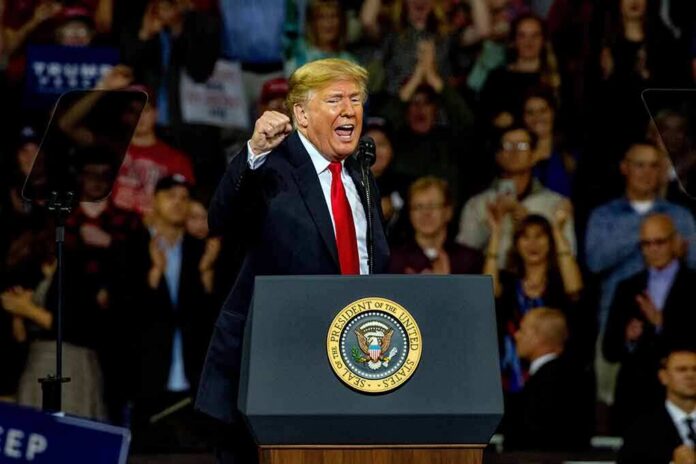
President Trump reversed course and restored in-person rallies in Iowa and Kansas for Sunday, adding them to a heavy slate of nearly 20 tele-rallies days before the midterms.
Story Highlights
- White House official says Iowa and Kansas rallies are back on for Sunday
- Reversal follows Thursday cancellations announced by party allies
- Schedule also features nearly 20 tele-rallies to reach voters
- Research shows rallies can give short-lived boosts in support
What Changed: From Canceled To Restored
On Thursday, Republican Party allies said President Trump canceled weekend rallies in Iowa and Kansas. They said he would instead phone into events across many states in the final sprint before Election Day. On Friday, a White House official announced the rallies were back on. The official said, “Rallies are BACK ON!” and noted Trump would pair the events with nearly 20 tele-rallies to reach more voters before Tuesday. The swing underscored the tight timeline.
United States News and World Report, citing a person familiar with the plans, reported Trump would hold back-to-back rallies in Iowa and Kansas on Sunday. The report framed the move as a reschedule after the initial cancellations. Local coverage in Kansas also echoed that sources expected a Sunday Kansas rally, with details pending, after the switch back to in-person events. Together, these reports showed a clear course correction heading into the final weekend.
Why Iowa And Kansas Matter Right Now
Campaigns use rallies to do several jobs at once. They excite core supporters, draw free local media, and show organizational strength. In the Midwest, late-stage visits also signal that races are close and worth the time. The Associated Press noted the earlier cancellations came despite competitive contests in those states. Returning to in-person stops suggests the campaign wants visible momentum on camera and in crowds, while still using broad tele-rallies for reach.
Research on rallies helps explain the timing. One peer-reviewed summary finds that rallies can signal popularity and momentum, which can shape media coverage and voter perception. A National Bureau of Economic Research working paper found that Trump’s rallies in 2016 produced a short-lived increase in support over Hillary Clinton, with effects lasting about a week. A VoxEU summary of the same research put the average bump at about 4.5 percentage points for roughly one week. That window lines up with the final push.
Blending Tele-Rallies With In-Person Stops
Thursday’s plan centered on tele-rallies to maximize contact across many states in very little time. Friday’s change kept that digital reach while adding two stage events where local news cameras and voters could see the president in person. That mix reflects a “clicks and mortar” approach that scholars say is common in modern campaigns: blend online scale with on-the-ground signals of strength near key voting moments. The goal is lift plus proof of life, all before Tuesday.
President Trump will hold two rallies Sunday – first Dubuque, Iowa (remarks 3pmET) – second Salina, Kansas (remarks 7pmET).
— Libbey Dean (@LibbeyDean_) October 30, 2026
For voters, the switch may feel familiar. Leaders in both parties shift plans when time is short and stakes are high. Supporters may see the restored rallies as commitment to show up. Critics may see the back-and-forth as reactive. Either way, the facts are clear: the Iowa and Kansas rallies are on for Sunday, and the campaign is stacking nearly 20 tele-rallies around them. That is a high-volume close to a costly and intense cycle.
Sources:
facebook.com, apnews.com, usnews.com, dawn.com, kwch.com, ideas.repec.org, papers.ssrn.com, academic.oup.com