

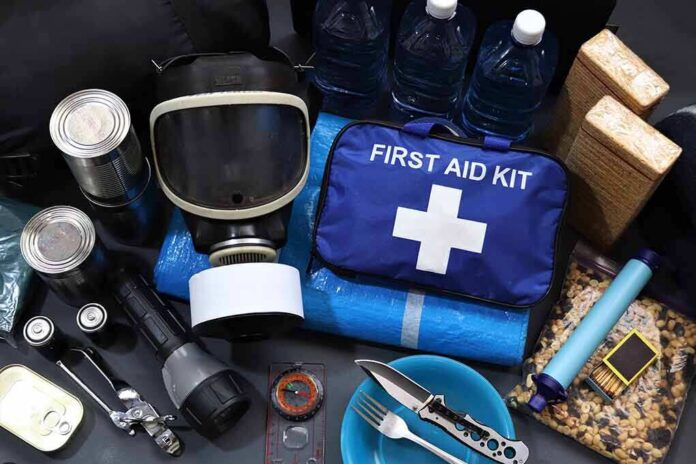
Europe has moved household preparedness from fringe hobby to public policy: the European Commission now tells every family to be self-sufficient for the first 72 hours of a crisis, anchoring that guidance in a continent-wide strategy rather than a patchwork of unofficial advice.
The Short Version
- The EU has adopted a minimum 72-hour household self-sufficiency target as part of its Preparedness Union Strategy.
- Brussels connects the target to concrete measures: emergency plans, “go-bags,” and basic first-aid skills.
- Recent cyber incidents affecting supermarket refrigeration illustrate how digital failures can disrupt daily necessities without a shot fired.
- The 72-hour benchmark standardizes a planning horizon across diverse hazards, complementing professional emergency response rather than replacing it.
What the EU actually decided: a new baseline for every household
The Commission’s preparedness architecture is explicit: households across the bloc should be able to meet essential needs on their own for a minimum of 72 hours, because those first three days are when emergency services face the steepest surge of demand. The guidance does not live in a brochure; it is codified inside the EU’s Preparedness Union Strategy and supported by implementation documents that define what “self-sufficiency” entails in practical terms. The policy frames 72 hours as a common, achievable baseline that reduces pressure on responders and buys time for authorities to stabilize critical services.
Critically, Brussels pairs the time target with actions ordinary people can take. Commission working papers call for household emergency plans, evacuation bags stocked with essentials, and baseline capabilities like first aid. The documents are written in the grammar of civil protection—clear roles, realistic horizons, common consequences—rather than in the vernacular of niche “prepping,” a signal that Europe is operationalizing personal preparedness as part of public safety, not as an alternative to it.
Why 72 hours matters: mechanism, not machismo
Seventy-two hours is not a talismanic number; it is a planning device. In the first one to three days of any large disruption—storm surge, grid failure, ransomware against a hospital network—supply chains are still re-routing, assessments are ongoing, and responders are stretched by life-safety calls. Households with water, shelf-stable food, light, communications backups, necessary medicines, and a plan are less likely to become secondary emergencies. The Commission’s guidance reflects that logic. It emphasizes “common consequences”—loss of power, disrupted payments, contaminated water—rather than trying to make citizens experts in every hazard. The effect is to align personal action with professional response windows, which is why the 72-hour threshold now sits alongside EU stockpiling and civil-protection initiatives as part of one system.
The choice of a standardized horizon also simplifies messaging. A single, minimum target creates a lingua franca across jurisdictions and sectors. Utilities, retailers, municipalities, and health systems can plan, train, and communicate against the same clock, reducing the ambiguity that undermines public compliance during fast-moving crises. That is the essence of “whole-of-society” resilience: not everyone doing everything, but everyone doing the right thing for a defined period.
From hacked fridges to empty shelves: everyday systems are now attack surface
Europe’s new guidance arrives amid incidents that show how modern life depends on ordinary, networked infrastructure. In late 2026, multiple supermarket chains across at least ten countries reported remote tampering with refrigeration controls; temperatures rose, food spoiled, and operators had to discard stock. The point is not that these attacks emptied Europe’s pantries; it is that they exploited ubiquitous commercial systems to create immediate, physical consequences in stores where most people buy calories and medicines. The reporting spans Belgium, Estonia, Finland, Ireland, Italy, Luxembourg, the Netherlands, Portugal, Germany, and Sweden, illustrating the cross-border character of both retail supply chains and their digital control systems.
French retailers were hit as well. Accounts describe at least hundreds of supermarkets affected across banners including Carrefour, Monoprix, Intermarché, and Coopérative U—again, mundane places where daily necessities are stored cold and sold fast. In a world where refrigeration plants, building-management systems, and point-of-sale networks are internet reachable and often uniformly configured, a mis-set parameter or a malicious script can force mass product disposal and operational downtime. That is not speculation; it is the published experience of operators and national outlets, and it underscores why civil protection doctrine now treats cyber-physical disruption as part of the same planning space as storms and floods.
This is strategy, not a headline reaction
The EU’s preparedness posture predates any single incident. The Preparedness Union Strategy, adopted in 2025, set the trajectory toward integrated, all-hazards resilience. It links EU-level stockpiling, cross-border mutual support, risk communication, and citizen preparedness under one umbrella. The 72-hour household target sits within that framework to standardize expectations and to make individual action legible to institutions—what responders can assume households can handle and for how long. The Commission’s civil-protection arm has been explicit that guidance, training, and communication are the levers to raise this floor uniformly across member states.
That broader shift reflects a simple reality: the definition of “security” has widened. Floods, heatwaves, industrial accidents, pandemics, cyberattacks, hybrid operations against infrastructure, and energy volatility now coexist in risk registers. The EU’s approach integrates these hazards not because they are equivalent, but because they share downstream consequences for households and services. Harmonized preparedness, especially in the first 72 hours, is the connective tissue across them.
What Brussels asks households to do—concretely
Read beyond the headline and the Commission’s checklist is pragmatic. Households should be able to meet essential needs—water, food, hygiene, light, critical medications, infant and pet supplies—for at least three days; keep copies of key documents; and maintain the means to receive official information when the power or mobile network is degraded. Families should have a rendezvous and evacuation plan, a compact “go-bag,” and basic first-aid skills. None of this requires a bunker; it does require deliberate stocking, periodic rotation, and a plan that every adult and older child understands. The aim is fewer preventable emergencies, not heroics.
For older adults and those managing chronic conditions, the guidance is especially salient. A three-day medicine buffer, backup for powered medical devices, and a written care plan can be the difference between continuity and crisis when pharmacies and clinics face outages or surges. For small businesses—the corner grocer, the pharmacy, the bakery—the same logic applies: modest contingencies for payments, refrigeration, and communications can sustain operations and the community they serve during the responder surge window.
How to think about the supermarket incidents—evidence and limits
The reported refrigeration attacks are instructive because they struck ordinary commercial gear at scale and forced tangible losses in multiple countries; that makes them a clear case study for why households should not assume uninterrupted access to food or payments in the first days of a disruption. Public accounts vary on exact counts and do not identify a perpetrator; those investigative details, while important to law enforcement and network defenders, do not change the preparedness lesson for citizens and local businesses. Digital dependencies can fail abruptly and widely. A three-day buffer at home—and sensible contingencies at work—converts that shock into inconvenience rather than hardship.
Implications: from message to muscle memory
Policy only matters if it becomes practice. The Commission’s documents give national authorities a common script; turning it into muscle memory requires local campaigns, retailer partnerships, primary-care reinforcement of medicine buffering, and periodic exercises that make the 72-hour horizon familiar. Done well, the result is not panic buying, but calm, incremental readiness: a few extra liters of water, a stocked pantry rotated into regular meals, batteries that are checked when the clocks change, and a family plan stuck to the refrigerator door—secured by a magnet, not a default password.
Sources:
americanpartisan.org, ec.europa.eu, cybersecuritydatabase.org, eur-lex.europa.eu, en.wikipedia.org, cnbc.com