
State commemoration is never just about the past; when the White House chooses to honor a partisan tribune, it signals who counts as a national figure and what ideals a governing coalition means to enshrine.
At a Glance
- The White House released a memorial video and statements honoring Charlie Kirk on the first anniversary of his death, presenting him as a consequential national figure.
- Official language framed Kirk as a “fearless patriot” who “changed the course of American history,” elevating his legacy from movement organizer to civic symbol.
- Turning Point USA and Republican leaders staged large-scale memorial events, including a convention tribute and stadium service, embedding remembrance within party ritual.
- Tributes emphasized Kirk’s fusion of Christian conviction with youth-centered activism; allies spotlighted his role as a moral as well as political influencer.
A White House Tribute That Defines, Not Just Reflects, Legacy
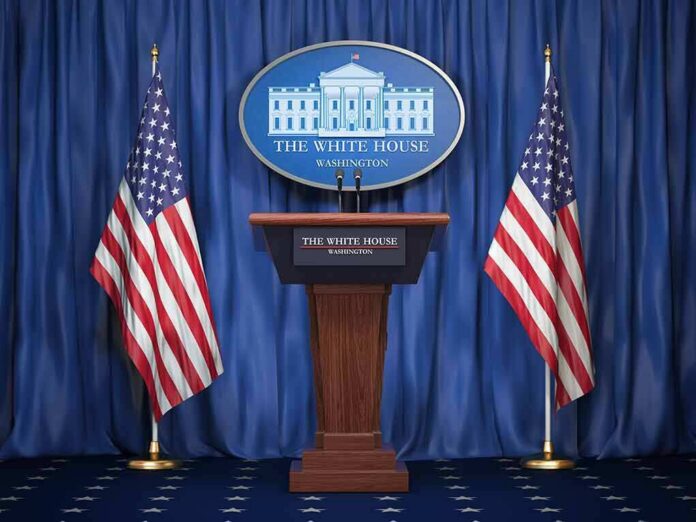
The decision by the White House to publish a dedicated memorial video and accompanying release in honor of Charlie Kirk crystallized the government’s view of his stature within American public life. The video packaging and the official channel carry weight: they translate partisan admiration into the language of national recognition. The administration’s own distribution apparatus foregrounded a set of phrases—“fearless patriot,” “champion for freedom,” and the sweeping claim that he “changed the course of American history”—that move beyond condolence and into canonization-by-communiqué. Anniversary coverage of the message reiterated those themes, underscoring the White House’s chosen frame for Kirk’s life and work.
In practice, that frame rests on two pillars. First, the memorials argue that Kirk’s organizational entrepreneurship—from campus tours to media appearances—constructed a durable pathway for conservative youth mobilization. Second, they insist that his leadership was rooted in an explicit theology that animated his political choices rather than merely justifying them after the fact. The net effect: the state and party infrastructures converged to present Kirk as a figure whose influence survived him because it had already been institutionalized.
How Commemoration Operates: Ritual, Reach, and Repetition
Formal tributes are mechanisms. They operate through ritualized events, controlled language, and repeated signals across platforms. In the Kirk commemoration, those mechanics were visible: a White House video release; party-aligned gatherings where a five-minute memorial reel played to a mass audience; and choreographed moments of praise from senior figures, including President Trump and Cabinet-level leaders. The staging matters. When a convention pauses its forward-looking project to dwell on memory, it invites the audience to read the loss not as an ending but as a mandate.
Turning Point USA extended that ritual into movement space, announcing and then executing memorial services scaled for arena-level participation. These programs placed Kirk’s biography in a liturgical setting—testimonies of faith, invocations of purpose, inviolable themes of family and nation—designed to reaffirm continuity of mission. The cadence of remembrance—annual markers, shared footage, consistent slogans—builds a layered memory architecture. Over time, that repetition stabilizes narrative: who he was, what he did, and why it must continue.
The Narrative Backbone: Faith-Driven Activism, Not Mere Partisanship
Allies argue that Kirk’s distinctiveness lay in his synthesis of assertive campus engagement with unapologetic Christian conviction. Witness accounts from those who worked alongside him emphasize a leader who prized open debate, insisted on moral discipline, and grounded strategy in theology—an ordering that, for his supporters, separates principled courage from performative outrage. In that telling, he was not simply a messenger for a party but a catechist for a generation, pushing norms of comportment even among close friends and high-profile collaborators.
The memorial lens also focuses on his final public appearances. Frank Turek’s firsthand account places Kirk onstage, answering tough questions—including on religion and contested social issues—moments before he was fatally shot, a detail that underscores the commemorative emphasis on courage in the arena rather than caution on the sidelines. In tributes across platforms, this immediacy—engagement up to the last minute—serves as the keystone in the movement’s portrayal of a life spent and spent fully.
Scale and Symbol: From Movement Organizer to Civic Figure
Symbols become civic when institutions adopt them. By distributing an official video and release, the administration converted movement memory into a statement of national acknowledgment, at least as the governing coalition conceives the nation. That elevation was reinforced by high-profile affirmations: President Trump’s eulogies and public praise, and recorded tributes from senior Republicans, framed Kirk as a standard-bearer—a phrase choice that carries implications for succession and stewardship of cause. The practical corollary is straightforward: once a figure is rendered emblematic, allied organizations can align fundraising, recruitment, and strategic messaging around the memorial narrative without appearing to exploit grief; they are, in a sense, executing the will the tribute declares.
The party’s convention choreography amplified this effect. A memorial interlude during a forward-looking political event signals that the virtues ascribed to the departed—fearlessness, moral clarity, persuasion—are not only nostalgically admired but programmatically required. The chanting, the montage, the unity language: these are not mere atmospherics but the connective tissue between memory and mobilization.
TPUSA pays emotional tribute to Charlie Kirk at anniversary memorial https://t.co/ri8OmjUEGm via @YouTube
Hard to believe this man is gone physically..yet his spirit is with us..his God, who we serve, is Everlasting..great sacrifice continues in all Christ followers..
— John Kish (@JohnKish20) September 11, 2026
Why This Model of Memorialization Endures
Political memorials often function as instruments of coalition-building, legitimacy-signaling, and agenda-setting—especially when the honoree is polarizing. The Kirk tributes track closely with that literature: consecration by community, inscription in institutional practice, and transmission through ritual. The move from private grief to public canon illustrates a consistent pattern across democracies: memorial projects tend to intensify commitments among adherents precisely because they locate meaning in a shared loss and assign duties in response to it.
In this case, the durability of the remembrance will hinge on whether organizations and leaders continue to tie visible outcomes—chapter growth, youth engagement, candidate pipelines—to the legacy they proclaim. The White House’s decision set a high watermark for honor; Turning Point USA’s staging supplied reach and repetition; party ritual offered reinforcement. Together, those layers create a scaffold sturdy enough for long-term memory work. Whether history judges the claim that Kirk “changed the course of American history” will depend less on the eloquence of tributes than on the persistence and fruit of the institutions that now carry his name.
Sources:
townhall.com, youtube.com, thenews.com.pk, whitehouse.gov, edmonton.citynews.ca, yorkspace.library.yorku.ca