

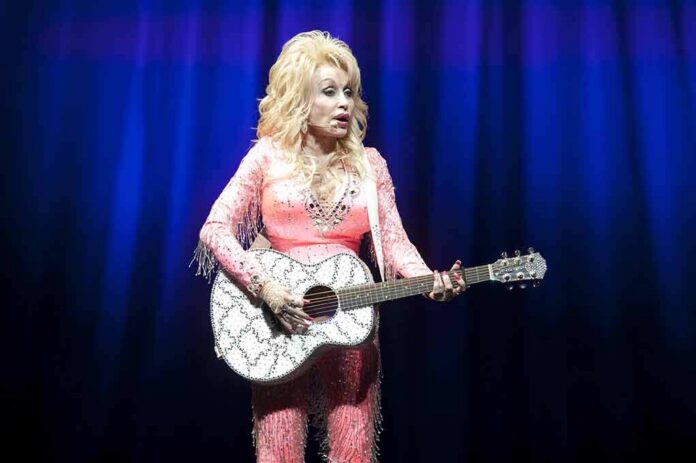
When a newsroom gets a face wrong, the error overwhelms everything else; audiences don’t remember the segment’s nuance, only the misidentification. CNN’s on-air use of a Dolly Parton impersonator’s photo during coverage of the icon’s death is a textbook example—quickly acknowledged, plainly apologized for, and still reputationally costly because visual mistakes are uniquely sticky.
At a Glance
- CNN aired a photo of Las Vegas tribute artist Kelly Vohnn in a Laura Coates Live segment about Dolly Parton’s death, then apologized.
- The network issued a direct statement of regret to the Parton family, as reported by multiple outlets with consistent detail.
- Visual misidentification is a common, high-salience newsroom failure class that can overshadow otherwise accurate reporting.
- Clear verification workflows for images—especially during breaking coverage—are the remedy; without them, one wrong frame can define a broadcast.
What Happened: A Straightforward Production Error with Outsized Visibility
During an evening broadcast of Laura Coates Live in the 11 p.m. ET hour, CNN aired a report on Dolly Parton’s death. In that segment, an image of Kelly Vohnn, a Las Vegas tribute performer who impersonates Parton, appeared on screen. CNN later acknowledged the error and apologized, telling reporters: “We regret the error and apologize to the Parton family.” Independent accounts from Entertainment Weekly and Variety describe the same sequence of events and identify Vohnn as the person in the mistaken photo, establishing the misidentification as an uncontested fact of the broadcast.
Multiple outlets reproduced the apology language and matched the basic timeline—an on-air segment about Parton’s passing, a wrong image, and a subsequent statement of regret—eliminating any real dispute about what occurred. That alignment across sources is precisely what separates a viral rumor from a verified newsroom error.
Why These Errors Happen: The Vulnerable Link Between Editorial and Production
Visual identification is a known weak point in broadcast workflows. Unlike a script—drafted, edited, and often vetted by legal or standards—graphics packages and b-roll pulls typically pass through asset libraries, agency feeds, and rapid-fire producer handoffs. Under deadline, the most common failure is not intent but matching: selecting a plausible image that carries the right aesthetic cues yet belongs to the wrong person. Industry guidance has warned for years that photo IDs demand a separate verification step: compare against multiple reputable samples, check reliable agency captions, confirm unique identifiers (context, location, era), and avoid relying on a single, unlabeled archive artifact.
Research on newsroom corrections underscores how even quickly fixed errors leave a mark because photographs feel self-validating; viewers trust what they can see. When the person pictured is not the person described, confidence in the newsroom’s judgment declines disproportionately to the underlying mistake, especially in breaking-news contexts where verification time is scarcest.
The Pattern Is Familiar—and Preventable with Discipline
Photo mix-ups are not rare. Media watchdog tallies and readers’ editor case studies over the past decade catalog recurring misidentifications across outlets and formats, often rooted in mislabeled archives, ambiguous captions, or assumptions made under pressure. The lesson is not that visual verification is impossible but that it must be formalized: redundant checks, source-of-truth image pools, and friction at the point of air—forcing a confirm-or-stop moment before a frame clears the control room.
Professional training emphasizes a handful of durable practices. First, build “gold master” folders of pre-verified images for high-profile figures; these are curated files with confirmed provenance, metadata, and usage rights. Second, require pair review—no single person both selects and captions a photo for air. Third, treat tribute segments and obituaries as high-risk for look-alike confusion, particularly with celebrities who have active impersonator circuits; require an affirmative check against agency captions and at least one authoritative reference image before publishing or airing.
Mechanics of a Robust Image-Verification Workflow
In practical terms, getting this right combines tooling and culture. Tooling means a digital asset manager with locked captions, visible provenance, and alerting for duplicates or look-alikes; agency photos should retain original caption text and creator credits, and internal uploads must include required fields (who, where, when, source). Culture means editorial leaders rewarding the minute or two it takes to cross-compare faces instead of punishing the delay; speed without accuracy is not a scoop in visual journalism—it’s a liability.
Verification steps that actually change outcomes are simple and specific. Compare the candidate image to two or more authoritative samples. Scrutinize era-consistent cues—hairstyle, wardrobe, stage backdrop, watermark. Validate captions against known biographical markers (venue, tour year, collaborators). If any element fails to align cleanly, discard the image rather than rationalize it. These are the exact practices Poynter and other standards bodies have long recommended because they work under pressure and scale across teams.
Why This Case Resonated: The Power of Iconography and the Cost of a Single Frame
Dolly Parton is not just a celebrity; she is an American cultural touchstone, and coverage of her passing carried the weight of a national obituary. In that setting, substituting a tribute artist’s portrait—even inadvertently—creates a jarring dissonance. Viewers experience it as a lapse in care at a moment that demands care most. Scholarship on journalistic error has repeatedly found that corrections, while ethically mandatory, do not neutralize the original harm to credibility because audiences encode the initial visual impression more strongly than the later textual fix.
For broadcast organizations, the implication is straightforward: high-signal moments must receive high-rigor processes. That doesn’t require exotic technology; it requires anticipating where production is likely to fail and installing cheap, reliable guardrails—gold-master image pools, pair checks, locked captions, and a bias toward omission when doubt persists.
A Fair Accounting: What Is Established and What Matters Next
The record here is clear: CNN aired an image of Kelly Vohnn, a Las Vegas Dolly Parton impersonator, during coverage of Parton’s death, then issued a direct apology to the Parton family. Those facts are consistently reported by multiple independent outlets and align on the key details of timing, program, and identity. As with any single production mistake, the durable lesson is procedural, not conspiratorial. Visual verification fails where it is not designed into the workflow; when it is, these errors virtually disappear.
Newsrooms that cover public figures with active impersonator communities—musicians, comedians, political figures—should explicitly flag impersonation risk in their editorial stylebooks and asset systems. The objective is not perfection but predictable reliability under pressure. In visual journalism, that reliability lives or dies in the last mile between a producer’s cursor and the control room’s switcher.
CNN has apologized to Dolly Parton‘s family and to a Las Vegas tribute artist after mistakenly airing a photo of the impersonator during coverage of the country icon’s death this week.
brief battle with cancer on Tuesday. Amid dozens of images spanning her decades-long career,… pic.twitter.com/esa50vG9kV
— The Hollywood Reporter (@THR) August 27, 2026
What Audiences Should Expect
Audiences have a right to expect that the face they see matches the name they hear. That expectation is neither naïve nor burdensome; it is the minimal standard of respectful, accurate storytelling. The fix is not abstruse. It is a disciplined process that privileges confirmed provenance over convenience and structures a broadcast so that one wrong photo doesn’t get the final say.
Sources:
foxnews.com, ew.com, variety.com, cnn.com, kotaradio.com, transcripts.cnn.com, nypost.com