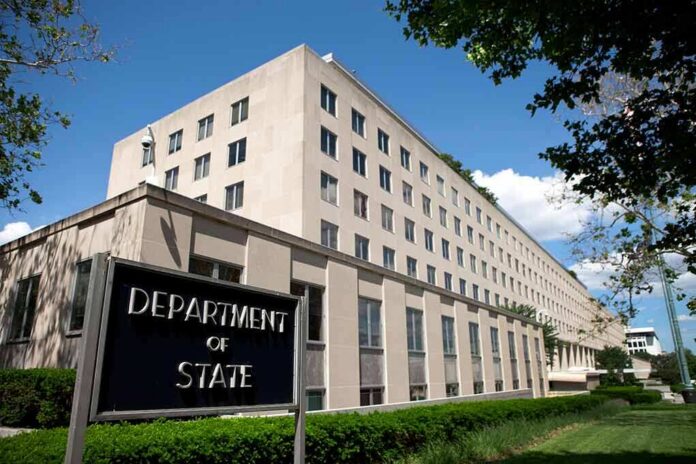
Washington’s new terrorist designation on a UK protest network broadens the war on terror into the realm of activist “direct action.”
Story Highlights
- The United States sanctioned the UK-based group Palestine Action as a Specially Designated Global Terrorist entity.
- The United Kingdom had already banned the group under the Terrorism Act 2000, and a UK appeals court upheld that ban in 2026.
- U.S. officials said the group supported acts of terrorism and urged similar tactics abroad, including near the U.S.-Mexico border.
- The move freezes U.S.-held assets and bars U.S. persons from dealing with the group, with broad compliance effects.
What The U.S. Decided And What It Does
The U.S. Treasury designated Palestine Action as a Specially Designated Global Terrorist entity on August 26, 2026, adding it to the Specially Designated Nationals list and triggering blocking rules for U.S. persons. Treasury sanctions like this freeze property in the United States and prohibit most transactions with the target, which can also push banks and platforms worldwide to cut ties. This step signals that Washington treats the group’s conduct as terror-linked under Executive Order 13224 authorities.
U.S. officials stated that the UK-based group has supported numerous acts of terrorism since 2020 and encouraged similar tactics in other countries, including inside the United States and along the U.S.-Mexico border. Public materials reviewed for this story do not include Treasury’s underlying designation memorandum or incident list. That limits public visibility into which acts and which leaders were tied to the legal basis for the action.
The UK Context And Court Backing
The United Kingdom proscribed Palestine Action in July 2025 under the Terrorism Act 2000, saying the group commits and participates in acts of terrorism. The UK Court of Appeal upheld that ban in June 2026, reversing a lower-court ruling and endorsing the Home Secretary’s judgment under the statute. UK proscription law allows banning groups that commit, prepare for, promote, or are otherwise concerned in terrorism, a definition broader than many people assume.
Proscription in the UK makes it a crime to belong to, support, or display symbols of the group, with penalties up to ten years in prison for several offenses. That framework shaped public debate even before the U.S. acted. Supporters argued that repeated property damage at defense-linked sites crossed into terrorism. Critics warned that turning protest into terrorism can chill speech and association beyond violent conduct.
How Palestine Action Describes Itself
Palestine Action calls itself a direct-action movement that targets companies it says enable Israel’s military, especially Elbit Systems and related logistics sites. The group says it uses focused, deliberate action to force change when institutions will not, and it frames property damage as a response to alleged war crimes, not terrorism. Its channels have highlighted actions in the United Kingdom, Europe, and U.S. cities, showing a networked campaign model.
United Nations human rights experts urged the United Kingdom in 2025 not to misuse terrorism laws against protest. They described the group as a national activist network promoting civil disobedience and direct action, and warned that proscription would criminalize a range of support activities. Those warnings now echo in the U.S. debate, where sanctions can also lead platforms and payment firms to restrict content and fundraising linked to a designated entity.
Why This Matters For Protest, Security, And Policy
This case shows how modern terrorism tools reach beyond armed groups into activist networks that use disruption and damage to make a point. The U.S. move follows the UK ban and court ruling, which strengthens an allied consensus but does not reveal the U.S.-specific evidence behind the designation. That opacity frustrates people across the spectrum who want clear, public facts, not just legal labels, when major penalties hit political actors.
From The Telegraph Editor PM
Connor Stringer
Chief Washington Correspondent
‘Palestine Action is to be designated a global terrorist organisation by the United States.’⁰⁰‘It is believed to be the first high-profile case of a British Left-wing activist group being subjected… pic.twitter.com/icSIlQgmsX— Mirino (@Morphobia) August 26, 2026
For conservatives, the action reads as long-overdue toughness against networks they see as crossing lines. For liberals, it raises fears that powerful agencies can brand protest as terror without sharing proof. For most Americans, it feeds a broader worry: the system often operates in the dark, guided by insiders, while ordinary people must accept the fallout. Transparency on the specific incidents and decision record would help test the government’s case and rebuild trust.
Sources:
insiderpaper.com, anews.com.tr, home.treasury.gov, aljazeera.com, en.wikipedia.org, uk.news.yahoo.com, ynetnews.com, bbc.com, jurist.org, palestineaction.org, global.palestineaction.org