

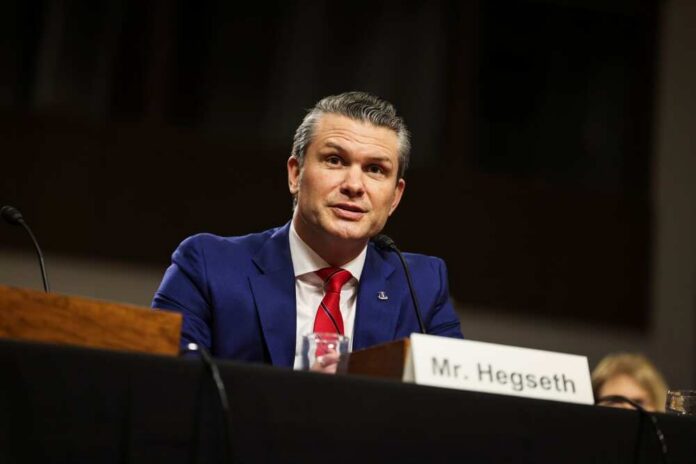
Defense Secretary Pete Hegseth drew loud “USA!” chants as he wrapped a Turning Point USA summit speech, spotlighting how politics and national security now mix on activist stages.
Story Highlights
- Pete Hegseth spoke at a Turning Point USA summit and exited to “USA!” chants.
- Official video confirms Hegseth delivering TPUSA-linked remarks from the Pentagon earlier this year.
- The appearance reflects how defense messaging now reaches youth activist audiences.
- Viral clips from such events often spread with limited context, fueling polarized reactions.
What Happened On Stage
Defense Secretary Pete Hegseth addressed students at a Turning Point USA summit in Tampa, Florida. C-SPAN recorded his remarks, verifying his appearance and role in the program. Event videos and posts showed him leaving the stage to chants of “USA!” from the crowd. That moment capped a high-energy session aimed at young conservatives. Organizers framed the program as a mix of policy talk and motivation. The reaction showed strong support for Hegseth inside that room.
Differing details about the exact policy lines in the speech circulated online soon after. Some posts claimed he outlined a new defense contracting approach. The public video record confirms his participation, not the full policy specifics. The Defense Visual Information Distribution Service also shows Hegseth delivering TPUSA-related remarks from the Pentagon earlier in the year, underscoring an ongoing link between his public messaging and TPUSA audiences. Those two verified touchpoints anchor what we can say with confidence.
Why This Venue Matters
Using a student activist summit as a stage for national security themes signals a strategy. The goal is to energize younger voters around defense priorities and patriotism. Past TPUSA programs have featured Hegseth and other high-profile conservatives, suggesting a long-running partnership between the group and top figures. For backers, this looks like smart outreach that meets an eager crowd where it gathers. For critics, it raises lines between governance, campaigning, and movement media.
In today’s Washington, both parties work activist circuits to shape the next generation. Republicans now control the White House and Congress. Democrats oppose key parts of the agenda from the outside. Many Americans in both camps still voice a shared concern: powerful players talk past everyday problems. They see rising costs, weak trust, and little accountability. A showy summit moment can feel exciting, but it does not by itself fix high prices, border stress, or long wait times for benefits and care.
The Viral Clip Problem
Short videos from political events often travel fast without full context. Researchers and reporters have tracked this pattern for years at conservative conferences and other rallies. A clip may amplify cheers yet skip the policy caveats. That gap can harden views online and bury facts under spin. The Tampa summit clip follows that path. It confirms energy in the room, but it leaves open what exact policies Hegseth detailed on stage beyond broad themes seen in official programs.
The students at CLS just erupted in cheers as @SecWar Pete Hegseth took the stage. The cheers then quickly turning into a loud USA chant !! @tpusastudents @TPUSA pic.twitter.com/9UMJW7ocX2
— Kyle Mattern (@KYLE_Mattern44) July 10, 2026
For readers trying to sort signal from noise, two checks help. First, look for primary records, like full-event videos, schedules, or transcripts from established outlets. Second, match strong claims to on-the-record sources. Here, C-SPAN documentation places Hegseth on the TPUSA stage, and Defense Department media confirms his earlier TPUSA-linked remarks from the Pentagon. Those anchors are solid. Claims beyond them need direct, verifiable sourcing before they are treated as fact.
What To Watch Next
Watch for formal policy releases that spell out any defense contracting changes. Clear text beats viral soundbites. Also track whether cabinet officials keep using activist stages to preview or sell policy during this election cycle. That choice can draw young audiences into national debates. It can also deepen the sense that government is run through rallies and social feeds, not steady public process. Many Americans, right and left, want less theater and more results they can see at home.