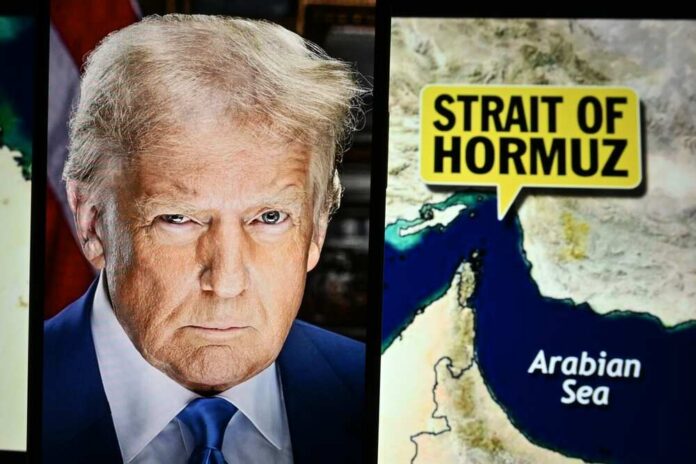
Despite President Trump’s assurances and U.S. Navy firepower, experts warn that restoring oil flows through the Strait of Hormuz could take months, exposing the limits of American military might against Iran’s cheap, effective asymmetric warfare tactics.
Story Snapshot
- Oil transits through the Strait of Hormuz have plummeted 90-95% as Iran deploys mines, drones, and missiles
- Over 340 tankers remain trapped in the Persian Gulf with insurance costs skyrocketing
- Military analysts warn securing the chokepoint requires at least 12 destroyers and could take weeks or months
- Trump issued a 48-hour ultimatum threatening strikes on Iranian energy infrastructure while Putin warns of complete shutdown
- Iran selectively allows passage to “friendly” nations like China, India, and Pakistan, possibly charging tolls
Navy Overwhelmed by Low-Cost Iranian Threats
The U.S. Navy destroyed 16 Iranian mine boats in recent weeks, yet daily transits through the Strait of Hormuz average just five vessels compared to pre-conflict levels. Military analyst Bryan Clark warns that effective escort operations would require approximately 12 destroyers, consuming virtually all regional U.S. naval forces. Iran’s asymmetric arsenal of inexpensive drones, naval mines, and anti-ship missiles presents challenges vastly different from the 1980s Tanker War, when American naval dominance proved decisive in protecting commercial shipping lanes.
Secretary of State Marco Rubio acknowledged that naval escorts remain a “post-conflict necessity” rather than an immediate solution, contradicting President Trump’s public assurances that Navy ships and superior equipment guarantee safe passage. Ellen Wald from Transversal Consulting emphasized that modern surveillance technology makes vessels impossible to mask, while Iran’s cruise and ballistic missiles pose threats that didn’t exist four decades ago. The narrow chokepoint handles roughly 20 percent of global oil supplies, with 80 percent destined for Asia-Pacific markets, yet no alternative routes exist for loaded tankers or liquefied natural gas carriers.
Hundreds of Tankers Trapped as Markets Panic
Approximately 130 crude and fuel tankers plus 210 product tankers remain stranded in the Persian Gulf, according to shipping data firms Kpler and Vortexa. Insurance costs have reached prohibitive levels as Iranian forces continue targeting vessels without authorized passage, striking over a dozen ships since conflict escalated roughly one month ago. Energy analyst Robert McNally from Rapidan Energy Group warned that investor assumptions about quick American military fixes are crumbling, noting that degrading Iranian threats sufficiently to restore confidence could require months of sustained operations.
President Trump floated welcoming limited Iranian-approved transits of “10 big boats” while simultaneously issuing a 48-hour ultimatum Friday demanding the strait reopen or face strikes on Iranian energy infrastructure. Iran has strategically allowed passage for vessels linked to China, India, and Pakistan while potentially implementing “toll booth” fees, undermining the principle of free international navigation. This selective enforcement gives Tehran leverage over nations dependent on Gulf oil while maintaining pressure on American allies and economic interests in the region.
Energy Crisis Looms Without Allied Support
Russian President Vladimir Putin warned that oil flows through the strait could halt completely within one month, echoing concerns from shipping industry experts about sustained disruptions. The crisis highlights America’s inability to unilaterally secure global energy chokepoints without substantial allied naval contributions, yet Trump has consistently pushed burden-sharing onto oil-dependent nations. Tim Wright from Kpler noted that Iran won’t ease restrictions even for friendly nations because doing so would undermine Tehran’s strategic leverage as a “pain point” against Washington and Gulf Arab states.
Strait of Hormuz Warning: The U.S. Navy Can’t Make the Oil Flow, Even If It Escorts Tankers and Destroys Drones and Missileshttps://t.co/zETFrponcd
— 19FortyFive (@19_forty_five) April 11, 2026
The situation exposes fundamental weaknesses in assumptions that American military superiority automatically translates into swift conflict resolution. Iran’s deep arsenal of difficult-to-detect mines, expendable drones, and land-based missile systems creates persistent threats that cannot be eliminated quickly through airstrikes or naval patrols. Global consumers face potential fuel shortages and price spikes if the standoff continues, while the federal government’s response reveals the gap between political rhetoric about protecting American interests and the complex military realities of asymmetric warfare in narrow maritime corridors controlled by determined adversaries.
Sources:
Strait of Hormuz: Iran oil war shipping, Trump insurance – CBS News
Iran’s remaining weapons: How Tehran can still disrupt Strait of Hormuz – Fox News
Securing Strait of Hormuz isn’t easy even with Navy, analysts say – Business Insider
Strait of Hormuz – Crisis Group