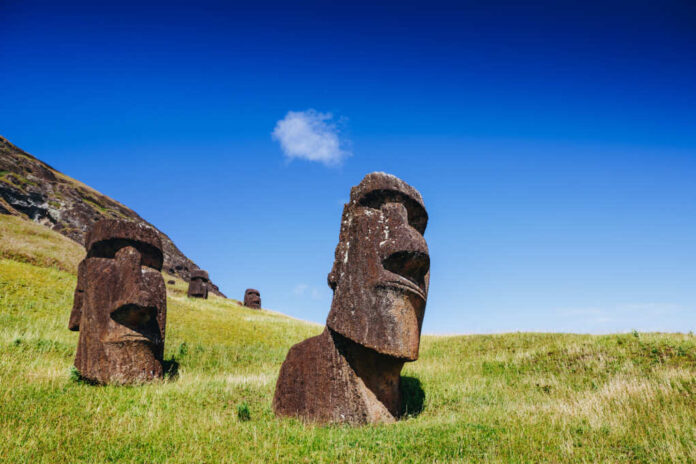
Scientists have finally cracked a 500-year-old mystery that has baffled explorers and archaeologists for centuries.
Story Highlights
- Researchers experimentally confirmed moai statues could move upright through coordinated rocking motion
- Ancient Rapa Nui people used ingenious engineering with ropes and small teams to transport 14-ton monuments
- Statue design features like forward lean and curved bases were specifically crafted for mobility
- Discovery validates indigenous oral traditions dismissed by modern academics for generations
Ancient Engineering Genius Validated Through Modern Science
Researchers conducting controlled experiments with moai replicas and sophisticated 3D modeling have definitively proven that Rapa Nui’s iconic statues could move upright across the island through a coordinated rocking motion. The breakthrough study demonstrates that small teams using rope systems could transport these massive monuments weighing up to 14 tons without requiring elaborate wooden rollers or sleds previously theorized by archaeologists.
Scientists just proved the moai could walk, solving a 500-year mystery https://t.co/xyrzXDLCq4
— Zicutake USA Comment (@Zicutake) October 8, 2025
Indigenous Wisdom Proves Superior to Academic Speculation
The scientific validation represents a stunning vindication of indigenous oral traditions that Western academics had long dismissed as folklore. For generations, the Rapa Nui people maintained that their ancestors made the statues “walk” to their final positions, but modern scholars insisted on more complex transportation theories. This discovery highlights how traditional knowledge often contains sophisticated understanding that surpasses contemporary academic assumptions about ancient capabilities.
Watch: Could the Moai Statues Walk? Examining the Science Behind the Mystery | Education
Deliberate Design Features Enabled Remarkable Mobility
The moai’s distinctive physical characteristics—including their pronounced forward lean and curved bases—were not artistic choices but calculated engineering decisions that facilitated movement. These design elements created the precise center of gravity needed for the rocking motion that allowed coordinated teams to guide the massive sculptures across Easter Island’s challenging terrain. The ingenious construction demonstrates the advanced technical knowledge possessed by Rapa Nui civilization.
Revolutionary Discovery Challenges Archaeological Orthodoxy
This breakthrough fundamentally reshapes understanding of how ancient civilizations accomplished seemingly impossible construction projects without modern machinery. The research provides concrete evidence that indigenous peoples developed remarkably sophisticated engineering solutions using available resources and human coordination rather than brute force methods. The findings underscore the importance of respecting traditional knowledge systems and questioning academic preconceptions about historical capabilities and achievements.
Sources: