
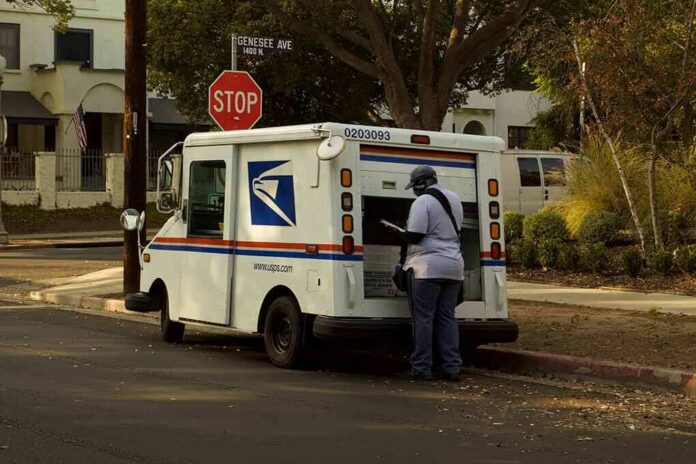
Federal prosecutors say a Kansas mail carrier kept 4,404 pieces of mail at home, including about 394 Republican campaign flyers, turning routine delivery into a breach of public trust.
Story Highlights
- A federal grand jury indicted a Kansas postal worker for unlawfully delaying and hiding mail.
- Agents reported finding 4,404 pieces of mail in the carrier’s garage on October 7, 2026.
- About 394 seized items were Republican campaign or political committee mailers, with none from other parties reported.
- The case arrives amid broader concerns over internal mail theft tracked by postal watchdogs.
What the Indictment Says Happened
The United States Attorney’s Office for Kansas announced that a federal grand jury indicted postal carrier Kelly R. Cram on one count tied to secreting, destroying, and delaying mail. The charging document alleges Cram worked as a rural-route carrier in Pittsburg, Kansas, when agents visited her home on October 7, 2026. Investigators say they found about 4,404 pieces of mail in her garage, including checks, letters, and campaign materials that should have been delivered to customers on her route.
According to the indictment, about 394 items were political mailers linked to Republican candidates or Republican Party-affiliated political action committees. The document states agents did not find political mail tied to other parties among the seized pieces. Local reporting mirrors those details and the single federal count for mishandling mail. Prosecutors did not list specific campaigns or recipients in the filing. The charge is an allegation, and Cram is presumed innocent unless proven guilty in court.
Why This Matters for Voters and Households
Political mail aims to inform voters about candidates and issues, and missing pieces can narrow what people see before an election. Residents also depend on the mail for bills, medicines, checks, and legal notices. When mail stays in a garage instead of reaching a mailbox, families feel it in real life. This case hits a basic promise: the government takes your letter and delivers it on time. When that promise breaks, trust in core services weakens across party lines.
The partisan makeup of the seized campaign flyers will draw attention. The indictment says agents found only Republican-related political mailers among the political pieces they seized. That detail feeds fears on the right about unequal treatment. Many on the left also worry when any gatekeeper fails, because public systems must be fair to work. The filing does not state a motive, does not name the campaigns, and does not detail how long the delay lasted, which limits what we can conclude about intent from the public record alone.
How Common Is Internal Mail Theft?
Internal mail theft by postal employees is a known, ongoing problem that watchdogs track. The United States Postal Service Office of Inspector General says it closed 5,961 internal mail theft cases nationwide from October 2019 through September 2023, illustrating steady enforcement activity across years. The same oversight community reports hundreds of thousands of mail-theft complaints overall in recent fiscal years, a reminder that the scale of reported issues is large even as proven internal cases are a smaller share.
These numbers show a larger pattern: most postal employees do their jobs, but a small share causes real harm when they do not. That is why investigators focus on both speed and proof. They seize items, build chain-of-custody records, and seek court authority where needed. In the Kansas case, the indictment centers on volume, location, and role: thousands of pieces found in a carrier’s garage, and duties that required delivery to customers. Those are the building blocks prosecutors will test in court.
What Happens Next in the Case
The criminal case will move through standard steps: an initial appearance, possible arraignment, and pretrial motions. Prosecutors will need to prove that the carrier knowingly and unlawfully delayed, hid, or destroyed mail. Defense counsel may challenge searches, the handling of the seized items, or links between specific pieces and the carrier’s assigned route. The indictment does not include a timeline of each withheld item, so route records and postal scans could become key evidence at trial.
A postal worker in Kansas on Election Day has been indicted for stealing 4,404 pieces of mail, which included around 400 Republican campaign flyers for voters.
It just never ends… pic.twitter.com/CbvjBFw9OA
— The SCIF (@TheSCIF) November 4, 2026
For citizens, two actions help. First, watch official updates from the court or the United States Attorney’s Office. Those filings carry the legal facts that matter. Second, track your own mail more closely during peak periods. Sign up for delivery alerts, report delays promptly, and keep records. Systems work best when people engage them. No matter your politics, honest mail service protects speech, commerce, and the daily life that ties communities together.
Sources:
foxnews.com, justice.gov, redstate.com, uspsoig.gov