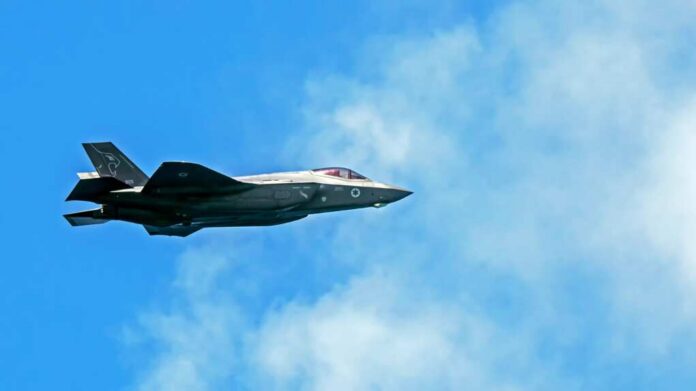
While American pilots fly standard F-35s, Israel operates a customized stealth fighter variant so advanced that the U.S. Air Force doesn’t have access to its unique capabilities—and recent combat operations against Iran prove it may be the world’s most formidable fighter jet.
Story Highlights
- Israel’s F-35I Adir features exclusive electronic warfare systems and weapons integration unavailable to U.S. variants
- The Adir dominated Iran’s air defenses during June 2025’s 12-Day War, striking nuclear sites undetected
- Israeli modifications include sovereign command-and-control systems and rapid update capabilities independent of U.S. approval
- Combat performance validates superiority over standard F-35s in high-threat environments against advanced air defenses
Sovereign Customization Born From F-22 Export Ban
The F-35I Adir exists because American export restrictions prevented Israel from acquiring F-22 Raptors in 2010. Israel demanded modifications to the F-35A platform that would preserve technological sovereignty, resulting in a unique variant called Adir, meaning “Mighty One.” Israeli defense contractors integrated proprietary electronic warfare systems, command-and-control networks, and weapons like Spice precision bombs. This open architecture allows Israel Aerospace Industries, Elbit, and Rafael to deploy rapid software updates without Pentagon approval cycles—a capability that gives Israeli pilots tactical advantages unavailable to American F-35 operators facing identical threats.
U.S. Delivers F-35 Lightning II Without AN/APG-85 Radar: $2 Trillion Stealth Program Faces Electromagnetic Warfare Setback
(CLICK LINK)https://t.co/uVnHUwD1ok pic.twitter.com/pHKE8FkbZQ— Defence Security Asia (@defence_asia) February 11, 2026
Battle-Hardened Performance Against Iranian Defenses
The Adir demonstrated its superiority during June 2025’s Operation Am Klevei against Iran. Over 200 Israeli jets, including approximately 40 F-35I aircraft, struck more than 100 targets on June 13, 2025, penetrating advanced air defenses derived from Russian S-300 and S-400 systems. Military sources confirmed Adir fighters “flew anywhere in Iran undetected,” targeting nuclear facilities and ballistic missile sites that threatened American interests and regional stability. Justin Bronk from the Royal United Services Institute called these operations “the most challenging F-35 missions” ever conducted, validating the aircraft’s stealth and electronic warfare capabilities against peer-level threats—operational environments American F-35s have never encountered.
Technological Edge Over U.S. Air Force Variants
The F-35I’s Israeli “app stack” enables electronic warfare tuning specifically optimized for Middle Eastern threat environments, including sophisticated radar systems Iran acquired from adversarial nations. This regional customization provides situational awareness and threat geolocation capabilities that standard F-35As lack. Israeli pilots benefit from real-time data fusion tailored to their operational requirements, while American variants remain constrained by generalized software updates designed for global operations. The Adir’s integration of Israeli-developed sensors and communications systems creates an information advantage that proved decisive during sustained combat operations, demonstrating how targeted modifications outperform one-size-fits-all approaches to fifth-generation air superiority.
Strategic Implications for American Air Dominance
Israel’s approximately 40 operational Adir fighters now set the benchmark for contested airspace operations, raising questions about whether American F-35 variants adequately prepare for high-end conflict. The 2025 war validated stealth fighter effectiveness against advanced integrated air defenses—a capability central to deterring adversaries threatening constitutional freedoms and American security interests. Israeli modifications, developed through combat experience against Iranian proxies since 2018, offer lessons the U.S. Air Force cannot ignore as China and Russia field comparable defensive systems. The Adir’s success bolsters arguments for operational flexibility over bureaucratic standardization, demonstrating how allied innovation strengthens collective defense capabilities while maintaining technological sovereignty essential to national security.
Post-war assessments confirm the F-35I suffered no losses despite Iranian propaganda claims, while integrating TR-3 and Block 4 upgrades that enhance processing power and sensor capabilities. The Israeli Air Force continues expanding its Adir fleet, with defense industry exports benefiting from combat-validated performance. This battle-hardened fighter represents not just Israeli ingenuity but a strategic asset that proved indispensable when confronting threats to regional stability and nuclear proliferation—threats that directly impact American security interests and the preservation of freedom against authoritarian regimes pursuing destabilizing weapons programs.
https://youtube.com/shorts/QPHFPCpuCyQ?si=WJ-JEDCTArAHoWvZ
Sources:
F-35I Adir: The ‘Battle-Hardened’ Custom Stealth Fighter Only Israel Can Fly
Israel’s Fights Against Iran Proving Capabilities of F-35I Stealth Jet
Lockheed Martin F-35 Lightning II Israeli Procurement
Ynet News: F-35I Adir Coverage
F-35 Lightning II: Israel