
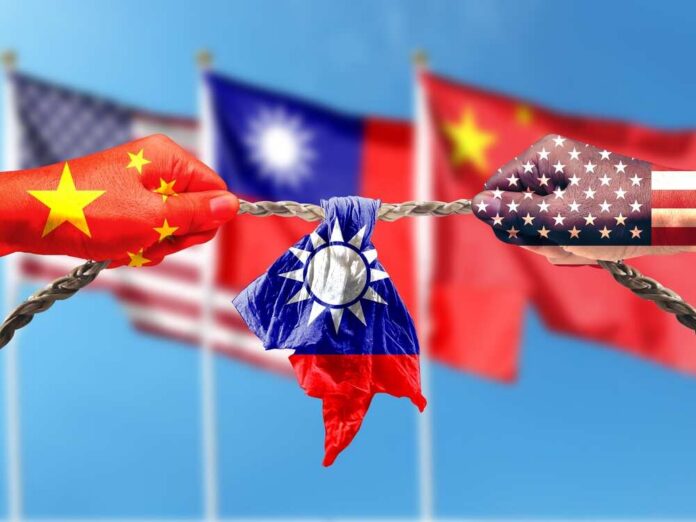
President Trump’s admission that he consulted Chinese President Xi Jinping on US arms sales to Taiwan breaks a 44-year bipartisan commitment and raises alarm about whether America’s security guarantees can be traded away for economic deals.
Story Snapshot
- Trump confirmed discussing Taiwan arms sales with Xi during a February 4, 2026 phone call, marking the first presidential consultation with China on such sales since Reagan’s 1982 Six Assurances explicitly prohibited it.
- A reported $20 billion arms package to Taiwan, including Patriot missile systems, remains unnotified to Congress as Trump pursues trade negotiations and prepares for a mid-May visit to Beijing.
- White House officials rushed to clarify that US policy under the Taiwan Relations Act remains unchanged, though experts warn the delay signals flexibility that emboldens Chinese aggression.
- The move reveals a troubling pattern where Washington elites prioritize short-term economic wins over strategic commitments, leaving allies vulnerable and questioning American reliability.
Breaking the Six Assurances Precedent
Trump’s February 17, 2026 remarks aboard Air Force One shattered a fundamental pillar of US-Taiwan relations established in 1982. President Reagan’s Six Assurances explicitly promised Taiwan that the United States would never consult with Beijing regarding arms sales, would not pressure Taiwan into negotiations with China, and would not mediate between the two parties. These guarantees formed the backbone of Taiwan’s defensive strategy for over four decades. Trump’s statement that he had “a good conversation” with Xi about arms sales and would “make a determination pretty soon” represents the first public acknowledgment by any US president of consulting China on this issue, undermining the credibility of longstanding American commitments.
Trade Deals Versus Strategic Commitments
The timing of Trump’s consultation with Xi reveals the administration’s calculus: leverage Taiwan’s security needs as a bargaining chip for economic concessions. The February 4 phone call occurred as Trump promoted a broader US-China trade deal involving Chinese purchases of American energy and agricultural products. Financial Times reported on February 7 that a $20 billion arms package for Taiwan was in preparation, yet months later Congress has received no formal notification. This tactical delay suggests the administration views military sales to democratic Taiwan as negotiable commodities rather than strategic imperatives. The approach prioritizes short-term economic gains over the long-term deterrence that keeps 23 million Taiwanese free from communist authoritarian rule.
Congressional Pushback and Policy Reality
Bipartisan hawks in Congress have consistently championed Taiwan’s defense needs, approving legislation like the Taiwan Security Act that mandates robust arms provisions. Trump himself approved over $18 billion in sales during his first term, demonstrating past willingness to defy Beijing’s objections. The Global Taiwan Institute assessed in April 2026 that this consultation likely represents a tactical slowdown rather than policy abandonment, predicting eventual sales expansion once Trump’s Beijing summit concludes. Yet the damage to perception matters: Taiwan’s military planners face uncertainty about delivery timelines for critical systems, while Xi gains propaganda victories showcasing American hesitation. Congress retains authority to override executive delays, but the episode exposes how presidential deal-making can undermine legislative intent and allied confidence.
The Broader Pattern of Elite Failures
This controversy exemplifies a frustration shared across the political spectrum: government officials prioritizing their own agendas over principled commitments. Trump’s defenders argue pragmatic diplomacy serves American interests by securing trade wins and avoiding conflict escalation. Critics counter that treating Taiwan’s survival as a negotiating tactic betrays core values of supporting democracies against authoritarian threats. Both perspectives converge on an uncomfortable truth—decisions made in Washington often reflect elite calculations divorced from the consequences ordinary citizens and vulnerable allies will face. Taiwan depends on American arms to deter a Chinese invasion that would reshape the Indo-Pacific balance of power, threaten global semiconductor supplies, and embolden other aggressors. When such vital interests become bargaining chips, it signals a government more concerned with managing headlines and stock markets than upholding the strategic foundations that have preserved peace for generations.
The situation remains unresolved as Trump’s mid-May Beijing visit approaches. Whether this episode proves a temporary delay or a dangerous precedent will depend on actions taken after the summit concludes. For now, both Taiwan and America’s other regional allies are left wondering if security guarantees hold firm when economic incentives point the other way—a question that undermines deterrence and invites the very aggression these commitments were designed to prevent.
Sources:
Will Trump Continue to Slow Arms Sales to Taiwan? – Global Taiwan Institute
Trump, Xi discuss Taiwan arms sales; White House says policy unchanged – Focus Taiwan