

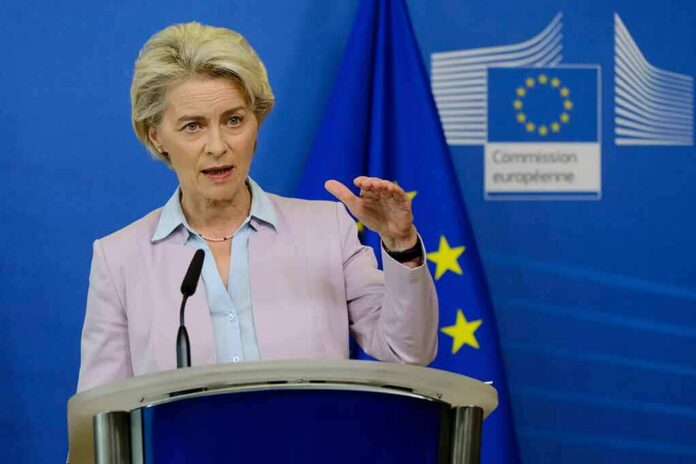
Europe’s top official publicly invited Canada to become the European Union’s first “associate member,” kicking off a high-stakes test of what power-sharing without full membership could look like.
Story Snapshot
- European Commission president urged an “association without accession” for Canada.
- CETA trade has grown sharply since 2017, giving a baseline for deeper ties.
- Key details and legal meaning of “associate member” remain undefined.
- Opposition at home and in Europe warns about sovereignty and real-world costs.
What Europe Proposed And Why It Matters
European Commission President Ursula von der Leyen told a Montreal audience that Canada cannot be a full European Union member because of geography, so she proposed “association without accession.” She framed the plan as a way to align on artificial intelligence, climate, energy, and security while stopping short of full membership. That public, on-record pitch created a concrete starting point for talks, rather than a rumor. It also raised core questions about who sets rules and how Canadians would keep a voice.
Supporters point to existing gains under the Comprehensive Economic and Trade Agreement. A joint Canada–European Union statement said two-way goods trade grew more than 75 percent and services trade rose 97 percent since provisional application began in 2017. Backers say those results show deeper cooperation could scale. They also note joint work already underway, like a February 2026 agreement on European defense procurement and a standing Economic Security Dialogue, which move the link beyond words.
The Missing Blueprint And Real Limits
The title “associate member” does not yet exist in European Union law. Reporting says the label is unprecedented and undefined, with no treaty text, voting rights, court rules, or exit terms on paper. That gap led European Union countries to edit summit wording away from “associate membership” and toward a softer “ever closer association,” reflecting pushback from several capitals. Until a draft exists, Canadians and Europeans cannot test the promises against actual rules, costs, or enforcement tools.
The pitch also runs into math and geography. Analysts estimate that about 70 to 75 percent of Canadian trade goes to the United States, and most military equipment is bought there, which makes fast European substitution hard. The Associated Press reported that new United States tariffs and talk about making Canada a “51st state” helped drive Ottawa toward Europe, but experts doubt that European Union trade can quickly offset North American dependence. That structural reality tempers hopes for rapid “decoupling.”
Sovereignty Fears, Sector Risks, And Political Pushback
Domestic and European critics warn about rule-taking without a vote. A Dalhousie University expert said if Canada joined the single market as an associate, rules would be made in Brussels, not Ottawa, and Canada would still have to comply. Opposition leader Pierre Poilievre equated the plan with a loss of sovereignty and called the summit a “theatrical meeting” full of vague declarations. Those claims resonate with voters on both sides who think elites cut deals first and explain the costs later.
🇨🇦🇪🇺 Canada could become the EU’s first-ever “associate member” by June 2027!
Prime Minister @MarkJCarney and @vonderleyen are pushing for an unprecedented partnership, bringing Canada closer to Europe without full EU membership.
🤝 Trade. Defence. Energy. Technology. Research.… pic.twitter.com/XnaMFyOoyE— euDebates.tv (@eudebates) October 31, 2026
Sector alarms are also real. A European Parliament member from France argued that current free trade with Canada is hurting European farmers, and a Canadian expert warned that subsidized European dairy imports could “ruin” Canada’s market if access expands. These are not abstract worries; they point to who could feel pain at home. Meanwhile, some European Union member states objected to the label before the bloc agreed on what it means, underscoring the political risk that process fights eclipse substance.
What To Watch For Next
Watch for an actual text. A draft that defines market access, standards, data rules, defense projects, dispute settlement, budget duties, and exit rights would move this from talk to test. Look for whether “associate” means rule alignment in key areas without a European Union vote, and what safeguards protect Canadian laws. Track whether any deal shows credible gains for workers and small firms, not only headline trade totals. Without these, the plan risks becoming another elite promise that everyday people cannot bank.
Sources:
youtube.com, audiovisual.ec.europa.eu, thecanadianpressnews.ca, international.gc.ca, cbc.ca, stcatharinesstandard.ca, reporter.mcgill.ca