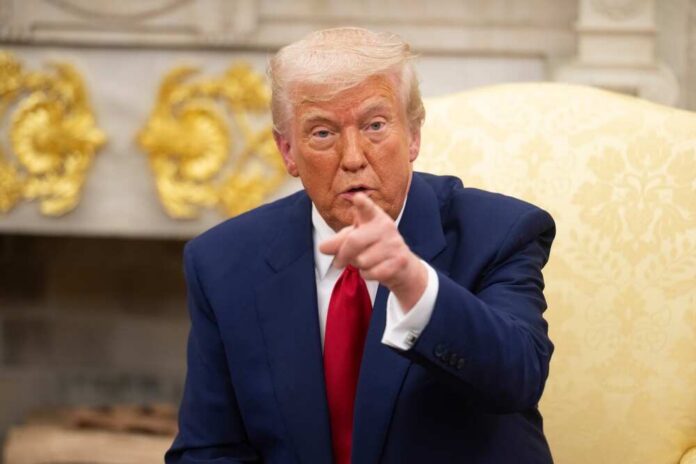
Donald Trump is again promising “accountability” for what he still calls the “rigged” 2020 election, even as years of court cases and official reviews say they found no proof the vote was stolen.
Story Snapshot
- Trump is renewing vows to go after those he says “rigged” the 2020 election, keeping the stolen‑election narrative alive six years later.
- Dozens of lawsuits and multiple reviews have not found credible evidence of widespread fraud that would have changed the 2020 result.[1][2]
- Both right and left increasingly see a system where political and legal “accountability” depends on which side holds power.[4]
- New threats and opportunities emerge as Trump’s rhetoric collides with a legal record that mostly rejected his fraud claims.[1]
Trump’s Renewed Talk of ‘Accountability’ and a ‘Rigged’ Election
Donald Trump has returned to one of the themes that has defined his political identity since 2020: that the presidential election was “rigged” against him and that “accountability is coming” for those he blames.[2] Trump has long framed post‑election investigations, impeachments, and indictments as part of a corrupt establishment’s effort to crush an outsider presidency, promising that, once back in power, he would seek accountability for those who pursued legal cases against him. That message resonates with many Americans who already believe powerful insiders manipulate the system.[4]
Trump’s language today builds on years of public messaging from his 2020 campaign and post‑election period, when he and his allies repeatedly claimed the election was stolen through fraud and irregularities.[2][4] Academic analysis of the 2020 race shows how partisan polarization helped those claims stick with many Republican voters even as courts and officials rejected them, because people tend to interpret evidence through party loyalty rather than neutral review.[4] That dynamic makes Trump’s latest promises of accountability potent, even without new public proof.
What the Legal and Evidence Record Actually Shows
Legal outcomes since 2020 tell a very different story from Trump’s rhetoric. A detailed review of post‑election lawsuits found that Trump and his supporters “lost every case of any consequence,” with judges, including Republican appointees, concluding that the evidence presented did not show widespread fraud or justify overturning results.[1] A peer‑reviewed statistical study in the Proceedings of the National Academy of Sciences examined key fraud allegations and reported “no evidence for systematic voter fraud” in 2020, finding that supposed anomalies fit normal election patterns.[2]
Nonpartisan election watchdogs warn that new or repackaged fraud claims should be treated with skepticism unless they come with verifiable data, clear methodology, and access for independent review.[3] The Brennan Center for Justice notes that “novel claims” of 2020 fraud often collapse when underlying data are checked, or when simple explanations such as reporting lags and mail‑ballot processing are considered.[3] In parallel, a comprehensive resource from States United Democracy Center catalogs state‑by‑state myths and facts, emphasizing that no state reported evidence of fraud on a scale that would alter the national outcome.
Trump’s Post‑Election Conduct and the Shift to Accountability Fights
As courts rejected fraud claims, the focus of institutions shifted from the integrity of the vote to the conduct of those trying to overturn it. A widely cited record documents efforts by Trump and allies to pressure state officials, advance alternate slates of electors, and challenge Congress’s count of electoral votes.[4] Federal prosecutors later brought an election‑obstruction case, alleging that Trump spread claims he knew were false to remain in power, reflecting a view that his actions were not routine political speech but potential criminal misconduct.
Democratic‑aligned groups argue that Trump and his allies are finally “starting to face accountability” through criminal charges, civil suits, and professional sanctions connected to attempts to subvert the 2020 result. At the same time, many conservatives see a double standard: they note that prosecutors aggressively pursue Trump while appearing far less interested in investigating irregularities, censorship concerns, or the role of intelligence and media elites in shaping what voters were allowed to see.[4] Both sides, in different ways, see a system where powerful actors rarely pay a price.
Why Both Sides Feel the System Is Rigged – Even in Opposite Directions
Scholars studying democratic accountability find that intense partisanship leads voters to assess evidence through a lens of tribal loyalty, often rewarding politicians for “fighting” rather than for telling uncomfortable truths.[4] That helps explain how, six years later, tens of millions of Americans remain convinced either that the election was stolen from Trump or that he is uniquely dangerous to democracy, even though they are looking at the same legal record.[2][4] Each side sees institutions as captured by the other’s elite.
For citizens who already believe a small group of insiders runs Washington for its own benefit, Trump’s fresh vow of “accountability” lands in a broader context of frustration: rising costs, culture‑war policies, unequal justice, and a federal government that rarely admits error.[1][3][4] Whether one thinks Trump is exposing corruption or weaponizing grievance, the deeper problem is the same. Without transparent evidence, consistent standards, and consequences for all sides, more Americans will conclude that the game itself is rigged—far beyond a single election.[4]
Sources:
[1] Web – Trump Says Accountability Is Coming Over The ‘Rigged’ 2020 Election
[2] Web – Biden Commitment Tracker – Foreign Policy for America
[3] Web – Donald Trump 2020 presidential campaign – Wikipedia
[4] Web – Trump Administration Accomplishments – The White House