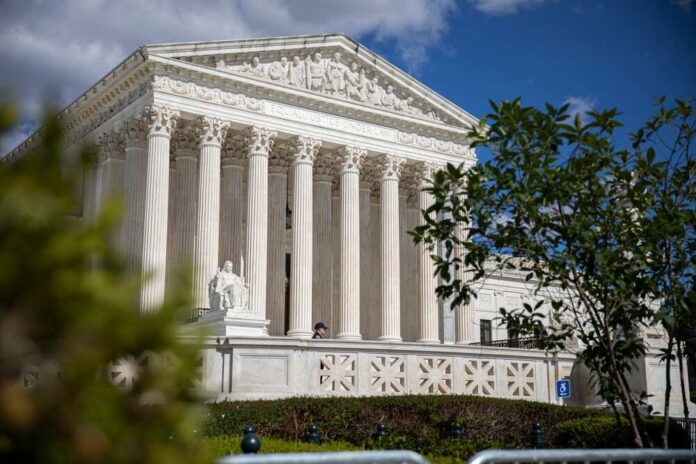
In the hours after the Supreme Court reaffirmed birthright citizenship, angry posts urging Americans to call immigration agents on pregnant undocumented women turned a long‑running constitutional fight into a new flashpoint over how far citizen enforcement should go.
Story Snapshot
- The Supreme Court’s Trump v. Barbara ruling kept birthright citizenship in place for children born to undocumented parents.
- Some activists now urge people to call Immigration and Customs Enforcement (ICE) on pregnant undocumented women to stop so‑called “anchor babies.”
- No law allows citizens to block birthright citizenship by reporting pregnancies, but ICE detention policies still put mothers and babies at risk.
- Both conservatives and liberals see the battle as proof that elites fight while ordinary families pay the price.
Supreme Court keeps birthright citizenship but sparks a new backlash
Six justices on the Supreme Court ruled in Trump v. Barbara that children born in the United States to parents who are in the country unlawfully are citizens at birth under the Fourteenth Amendment. The majority opinion by Chief Justice John Roberts said these children are “subject to the jurisdiction” of the United States and so fall under the plain language of the Constitution. That means the Court struck down President Trump’s Executive Order 14160, which tried to deny citizenship to those children. The ruling left many conservatives feeling that the Court ignored serious border and security concerns.
Justice Samuel Alito’s dissent argued that birthright citizenship for children of temporary visitors or undocumented parents can pose national security risks and invite abuse of America’s generosity. Justice Brett Kavanaugh agreed the Trump order was illegal under current law but wrote that Congress could change the federal citizenship statute, Section 1401, to add new limits. These opinions have become rallying points for commentators who say the Court closed one door but opened another by hinting that lawmakers still have power to act. President Trump echoed that anger in posts calling the decision “too bad for our country” and warning that it could be exploited.
What “anchor baby” calls are urging people to do – and what the law actually says
The online push tells Americans to watch for pregnant undocumented women and call Immigration and Customs Enforcement so agents can detain or deport them before they give birth. Supporters claim this is a patriotic way to stop “anchor babies” and protect national security. But there is no federal law or court ruling that says reporting a pregnancy can prevent a child from becoming a citizen. The Supreme Court, in both the 1898 Wong Kim Ark case and Trump v. Barbara, has treated place of birth in the United States as the key fact for citizenship, not whether a parent was reported to ICE.
Most legal scholars say the Fourteenth Amendment’s phrase “subject to the jurisdiction thereof” has already been interpreted to cover nearly all children born on United States soil, except those of foreign diplomats. The Wong Kim Ark decision upheld citizenship for a man born in San Francisco to Chinese parents who were not citizens, and modern courts have treated undocumented parents the same way. Congress has talked for years about changing birthright rules but has never passed a law that survived judicial review. So even if ICE detains a pregnant woman, the child she later has inside the United States is still a citizen under current law.
ICE detention policies and the real risks for pregnant women and babies
Immigration and Customs Enforcement’s own directives say pregnant, postpartum, and nursing people should generally not be detained, and if they are, it should be only in rare cases. Yet reports from the American Civil Liberties Union describe pregnant and postpartum women in immigration custody being denied prenatal care, given poor food, and kept in unsafe conditions. A coalition of doctors and advocates found that policy changes in recent years ended the common practice of releasing pregnant detainees, leading to more time in custody despite known health risks.
The Women’s Refugee Commission and Physicians for Human Rights documented cases where immigration officers did not even ask arrested parents about their young children and separated families while mothers were pregnant or had just given birth. A letter signed by Senator John Hickenlooper and other senators pressed the Department of Homeland Security to explain why pregnant women were still being held and urged the agency to stop detaining them except in exceptional situations. Together, these records show that detention can mean real harm for women and babies, so viral calls to “just call ICE” are not a simple law‑and‑order move; they carry serious human costs.
Public opinion, elite battles, and why many feel the system is broken
Polls in 2026 found that nearly two‑thirds of Americans oppose ending birthright citizenship, even as debates over undocumented immigration remain heated. That mix fuels frustration on both sides. Many conservatives over 40 feel courts and past “globalist” policies ignore their worries about border security and strain on public services. Many liberals over 40 see “America First” crackdowns and ICE raids as proof that vulnerable families are being targeted while the wealthy stay insulated. Both groups watch the Supreme Court fight and the harsh detention stories and feel the federal government talks about values, but fails real people.
Following the U.S. Supreme Court’s recent ruling related to birthright citizenship, the Oversight Project, a pro-Trump policy organization, has proposed an immigration enforcement strategy urging U.S. Immigration and Customs Enforcement (ICE) to prioritize the removal of pregnant…
— United States Position(U.S. P) (@WizarGod) July 1, 2026
Some commentators use harsh language about “anchor babies,” while civil rights groups describe systemic abuse of pregnant women in detention and link these tactics to a wider history of denying rights based on race and status. Scholars point out that birthright citizenship was written after the Dred Scott decision, which said Black people could never be citizens. That history makes many wary of any move that would again let the government decide who “really” belongs. For readers across the spectrum, the viral push to call ICE on pregnant women looks less like a precise legal strategy and more like another example of elites turning neighbors into informants while the deepest problems of immigration, health care, and economic opportunity go unaddressed.
Sources:
thegatewaypundit.com, en.wikipedia.org, nbcnews.com, youtube.com, cfr.org, supremecourt.gov, americanimmigrationcouncil.org, aclu.org, pmc.ncbi.nlm.nih.gov, womensrefugeecommission.org, plannedparenthoodaction.org, 19thnews.org