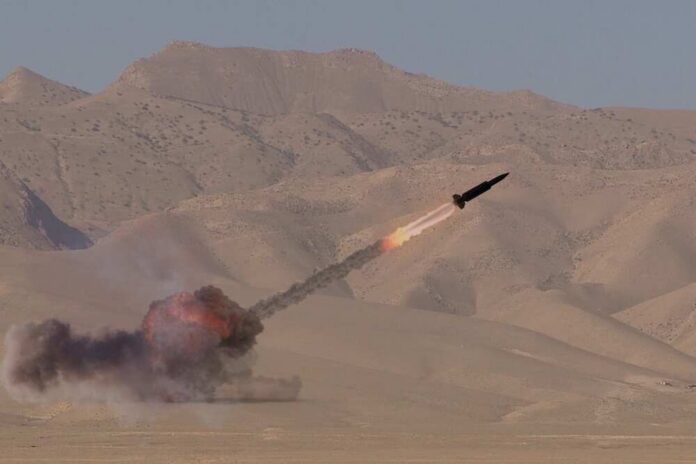
As missiles flew in a fresh Iran–Israel exchange, Yemen’s Houthi movement claimed it joined the barrage—raising the stakes of a regional proxy web that threatens American allies and global trade.
Story Snapshot
- Reports confirm new Iran–Israel missile exchanges; Houthis claim participation amid the chaos [1][2].
- Attribution remains murky as media compress overlapping strikes; facts support incoming fire, not Houthi impact [1][2].
- Interceptions reportedly limited damage, underscoring Israel’s layered defenses and the fog of fast-moving conflict [1][3].
- Escalation spotlights Iran’s proxy network and why U.S. resolve, deterrence, and energy security matter [4][11][12].
Fresh Missile Exchanges Reported Across the Region
Fox News reported that Iran and Israel exchanged missile fire late Sunday, describing a fresh escalation following Israeli operations against Hezbollah in Lebanon and subsequent Israeli retaliation on Iranian targets [1]. Additional coverage frames recurring cross-border launches as part of an intensifying cycle that has repeatedly drawn in regional actors [2]. These accounts establish a verified environment of active missile activity aimed at Israel, which is the backdrop for the Houthis’ claim of participation, even as specific launch attribution can be difficult to pin down in real time.
Video reports and live updates tracked launches and retaliatory strikes within hours of each other, a pattern that fuels confusion over who fired what and when [3][4][5]. This rapid sequence is common in the Iran–Israel theater, with overlapping operations, competing statements, and evolving official readouts [12]. The consequence is that while incoming fire is clear, firm attribution to any single actor—particularly Yemen’s Houthi movement—often remains unsettled until later technical assessments emerge, if they are made public at all.
Houthi Claim Meets a High Bar for Proof
The Houthi assertion comes amid a long-running Iranian proxy strategy that has included missile and drone threats from multiple fronts, including Yemen, Lebanon, Syria, and Iraq [12]. The available reporting primarily attributes the current missile salvos to Iran itself, while showing Israel’s defenses engaging inbound threats [1][2][3]. That leaves a gap between the Houthis’ claim and publicly verifiable evidence of effective Houthi-launched impacts on Israeli territory in this specific exchange. In short, claims exist, incoming fire existed, but proof of Houthi effect remains thin in the immediate record.
Israel’s defensive systems reportedly intercepted the incoming missiles, limiting casualties and damage in the current round, according to contemporaneous accounts that cite official statements and on-scene reporting [1][3]. Consistent interception data does not disprove Houthi launches, but it undercuts any narrative of successful, damaging strikes attributed to them in this phase. It also reinforces a central reality of the conflict: Israel’s layered air defense and early-warning capabilities remain critical to blunting the combined pressure of Iran and its network of partners.
Why Americans Should Care: Deterrence, Energy, and the Cost of Chaos
Iran and Israel’s confrontation has repeatedly widened beyond their borders, implicating sea lanes, energy prices, and the credibility of Western deterrence [10][11][12]. Britannica’s account of the 2026 phase highlights the scale and tempo of strikes across multiple domains, underscoring how quickly localized firefights can rattle markets and disrupt supply chains [11]. For Americans already squeezed by years of inflation and high energy costs, each escalation risks renewed price shocks and insurance premiums on maritime routes—costs that filter back to household budgets and small businesses.
Brookings and historical summaries describe a pattern: Iranian and Israeli strikes trigger responses from aligned militias, which then invite counterstrikes that blur lines of attribution and accountability [10][12]. This fog of conflict is not just a battlefield feature; it is a strategic tool. Proxies claim victories to project strength, Tehran tests red lines at arm’s length, and adversaries crowd the radar in an attempt to saturate defenses. Americans should recognize that clarity, discipline, and credible red lines—backed by defensive strength—are essential to prevent proxy warfare from dictating global prices and U.S. security choices.
Sources:
[1] YouTube – Yemen’s Houthi rebels claim missile attack on Israel
[2] Web – Trump orders Iran, Israel to stop firing after fresh round of …
[3] Web – Israel and Iran exchange missile fire as tensions escalate
[4] YouTube – Israel strikes Iran after taking missile fire
[5] YouTube – Israel, Iran exchange strikes in serious escalation of war
[10] YouTube – War Breaks Out! Israel Attacks Iran | Massive Missile …
[11] Web – The road to the Israel-Iran war – Brookings Institution
[12] Web – 2026 Iran war | Explained, United States, Israel, Strait of Hormuz …