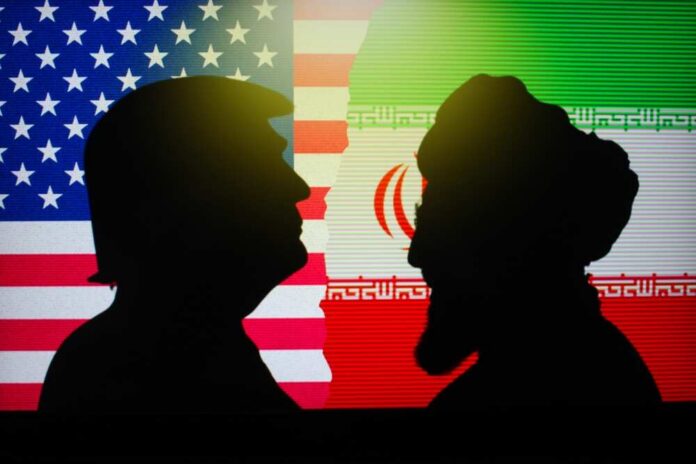
Iran’s IRGC is openly threatening to starve the world of oil “for years,” turning energy into a weapon just as Trump escalates pressure over the Strait of Hormuz.
Quick Take
- The IRGC declared its “restraint is over” and warned it will target U.S.-linked and partner energy infrastructure across the region.
- The threats arrived within hours of President Trump’s ultimatum tied to the Strait of Hormuz, a chokepoint for roughly one-third of seaborne oil.
- Iran announced a new strike wave—“Wave 99 of Operation True Promise 4”—claiming missiles and drones were launched toward U.S. bases and interests.
- Reports broadly align on the rhetoric and timing, but specific target damage and operational details remain hard to verify.
IRGC Shifts From “Restraint” to Explicit Energy-Warfare Threats
Iran’s Islamic Revolutionary Guard Corps (IRGC) issued a blunt message on April 7, 2026: the period of “restraint” is finished, and future retaliation will no longer spare regional partners hosting U.S. forces or supporting U.S. operations. Multiple outlets reported the IRGC warning that it can strike infrastructure in a way that deprives America and its allies of regional oil and gas supplies for years, not days.
That framing matters because it signals intent to raise the cost of confrontation beyond battlefield losses, aiming instead at everyday life—fuel, shipping, electricity, and inflation. For U.S. voters already worn down by high living costs and energy price spikes, the message is straightforward: Tehran believes America is vulnerable where it hurts most, and it is trying to exploit that pressure to reshape U.S. decision-making.
Trump’s Strait of Hormuz Ultimatum Collides With Iran’s Chokepoint Leverage
The IRGC statement landed just hours after President Trump set a hard deadline tied to the Strait of Hormuz, threatening devastating consequences if Iran failed to open the passage. The Strait’s role as a global energy artery makes it uniquely valuable as leverage, which is why Iranian officials and IRGC-linked channels repeatedly connect military warnings to oil flow. In this standoff, each side is signaling it can impose catastrophic costs quickly.
The broader context is a conflict already measured in weeks, with reporting describing 39 days of U.S. and Israeli operations against Iran by the time the IRGC issued its latest warning. Tehran’s logic, as described in the coverage, is deterrence by disruption: if Iranian petrochemical and oil facilities are hit, the response will not be confined to military targets. Instead, Iran claims it can trigger an energy crisis that ripples globally.
“Wave 99” Claims Highlight Capability, But Verification Gaps Remain
Iran’s messaging was paired with a specific operational claim: “Wave 99 of Operation True Promise 4,” reportedly launched at dawn using ballistic missiles, cruise missiles, and offensive drones. Iranian statements said strikes were aimed at U.S. bases and interests in the Persian Gulf and around the Strait of Hormuz, with additional references to military concentrations in Israeli-held areas. Those claims strengthen the intimidation campaign by implying sustained capacity.
At the same time, the publicly available reporting summarized here does not fully validate exact targets hit, the scale of damage, or the effectiveness of the reported launches. That limitation is not trivial. In past Middle East escalations, propaganda and fog-of-war claims often outpace confirmed assessments. Readers should separate two things: the verifiable fact that the IRGC issued sweeping threats, and the harder-to-confirm details about what specific sites were damaged and to what extent.
What This Means for U.S. Households, Markets, and “Deep State” Distrust
The most immediate risk is volatility in energy markets. Threats against regional energy infrastructure and shipping lanes can move prices even without a confirmed attack, because traders price fear and uncertainty. For Americans, that can show up fast at the pump and in shipping-related costs that feed inflation. For conservatives skeptical of past policies that tightened energy supply and raised costs, the episode reinforces why energy security is national security.
The episode also feeds a bipartisan frustration: too many major decisions feel distant, elite-driven, and reactive—while ordinary families absorb the consequences. If the conflict widens, Washington will face pressure to protect Americans from price shocks and supply disruptions while avoiding an open-ended war. The political test for the administration and Congress will be whether they can act decisively, communicate clearly, and avoid the kind of bureaucratic drift that convinces voters the system serves itself first.
Sources:
Iran vows to cut off US oil and gas ‘for years,’ declaring ‘restraint is over’
IRGC warns neighboring countries restraint has ended
IRGC threatens global energy supply, declares end to regional restraint