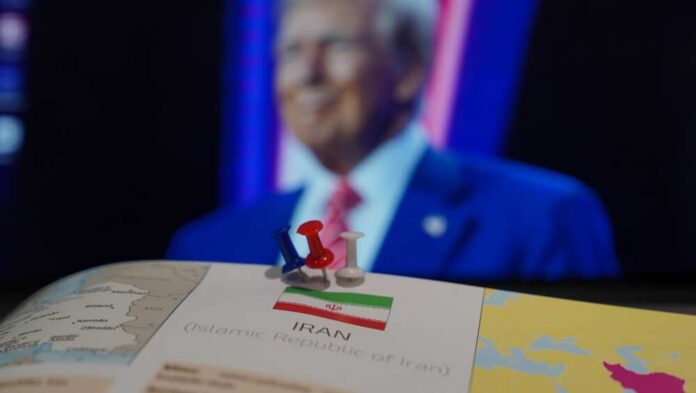
President Trump says Iran has “agreed to everything” and will hand over its enriched uranium—yet the public evidence of a finalized deal still isn’t there.
Quick Take
- Trump said April 16–17 that Iran agreed to surrender its enriched uranium stockpile—what he called “nuclear dust”—as talks continue after recent U.S.-Iran fighting.
- Multiple reports note there has been no public Iranian confirmation of the sweeping concessions Trump described.
- The administration has paired diplomacy with pressure, including warnings of a blockade and additional strikes if negotiations collapse.
- Conflicting claims about money and sanctions relief—especially reports tied to a possible $20 billion release—highlight how much remains unverified.
Trump’s claim: uranium surrender is “very close,” but details are thin
President Donald Trump told reporters at the White House and later reiterated in a NewsNation phone interview and a Truth Social post that Iran has “agreed to everything,” including giving up its stockpile of enriched uranium. Trump framed the moment as a breakthrough following recent conflict, saying the U.S. is close to a peace deal and that Iran will forgo nuclear weapons. The core gap is verification: public reporting cites no confirmed Iranian acceptance of these terms.
The timing matters because Trump’s remarks land in the middle of delicate, indirect diplomacy and a fragile ceasefire. Reports place talks in Pakistan around April 17, but also indicate they ended without a finalized agreement. That leaves Americans with two parallel realities: a White House message of near-complete Iranian concessions and an outside picture showing ongoing bargaining, unresolved logistics, and no public sign that Tehran has signed up to the sweeping “everything” Trump described.
Military pressure set the stage, but the endgame remains unsettled
The latest diplomacy follows “Operation Epic Fury,” described as early-2026 U.S. and Israeli strikes on Iranian nuclear sites such as Fordow and Natanz, including the use of B-2 bombers. Accounts of the operation emphasize how hard power reshaped the negotiating table by damaging facilities and degrading Iranian defenses. In practical terms, the administration is arguing deterrence and force created leverage—an approach many conservatives prefer to open-ended deals that rely primarily on trust and international paperwork.
Defense Secretary Pete Hegseth underscored that leverage by warning of a blockade and renewed bombing if there is no deal. That posture highlights a central tradeoff: higher short-term risk of escalation in exchange for terms that, if verified, could reduce the long-term risk of a nuclear-armed Iran. The public record in the reporting, however, does not yet show the crucial “how” of a uranium transfer—who takes custody, where it goes, and what inspection regime confirms Iran is complying.
Iran’s public stance on enrichment rights complicates “agreed to everything”
Another reason analysts are cautious is Iran’s stated position that its right to enrich is “indisputable,” even if enrichment levels are negotiable. That claim clashes with the broad sweep of Trump’s “agreed to everything” language and with reported U.S. demands, including a long halt to enrichment. Reporting also references a gap between U.S. demands for a much longer freeze and an Iranian counteroffer involving a shorter suspension, suggesting the core issue is still contested.
Money, sanctions relief, and public trust: the verification test ahead
Financial terms may become the political flashpoint. Trump publicly denied that money would be exchanged for the enriched uranium, while separate reporting referenced a war-end plan that included a possible release of roughly $20 billion in frozen assets—described as unconfirmed. That discrepancy is not a minor detail for taxpayers who are wary of past arrangements that traded cash or relief for promises later disputed. If an agreement exists, the public will expect clarity on whether any funds move, under what conditions, and with what enforcement.
Trump says Iranians have "agreed to everything," including removal of enriched uraniumhttps://t.co/ufo3YQuXau
— MSN (@MSN) April 17, 2026
The broader significance is domestic as well as international. After years of public frustration that Washington serves insiders over citizens, any high-stakes foreign deal faces a credibility problem unless terms are transparent and independently verifiable. A genuine removal of enriched uranium would be a major nonproliferation win, but the reporting available so far shows key unknowns: no public Iranian confirmation, uncertain terms, and conflicting narratives about concessions and compensation. Americans should watch for verifiable steps, not slogans.
Sources:
Trump says Iran has agreed to hand over enriched uranium
Iran International report on April 17, 2026 U.S.-Iran talks and related claims
Jerusalem Post report on Trump’s statement that Iran agreed to hand over enriched uranium
UPI: Iran will surrender enriched uranium, Trump says, as talks continue