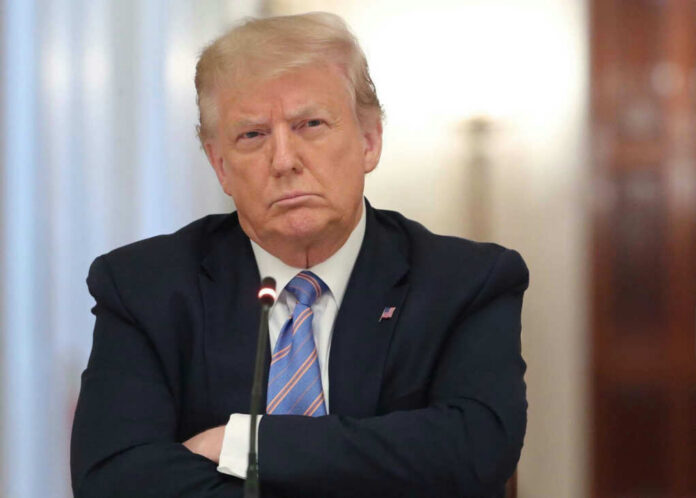
Trump’s “RINO purge” has moved from tough primary talk to real-world firings inside the national-security bureaucracy—fueling cheers on the right and alarm on the left.
Quick Take
- Trump’s 2021 call to primary “RINOs” who backed a $1.2 trillion infrastructure deal signaled a loyalty-first approach inside the GOP.
- By 2025–2026, that loyalty test broadened beyond elections into the executive branch, especially the Pentagon and intelligence community.
- Trump fired senior military leaders in February 2026 and moved to replace them with nominees viewed as aligned with his agenda.
- Supporters see accountability and alignment; critics warn the firings could weaken professional norms and readiness.
From “primary them” to “replace them”: how the purge narrative started
Donald Trump’s modern “RINO” campaign traces back to November 2021, when he blasted Republicans who supported the Democrats’ $1.2 trillion infrastructure bill and urged primary challenges against multiple House members, plus Sen. Lisa Murkowski. The message was simple: voting with Democrats on major spending packages could carry political consequences. That episode also showed a complication—some named targets argued their votes didn’t match Trump’s framing.
The term “RINO” has been around for decades, but it became a shorthand in the post-2016 GOP for moderates or institutionalists who resisted Trump’s agenda. In practice, the label is applied unevenly, depending on the fight of the moment—spending bills, impeachment, or “America First” priorities. The 2021 infrastructure flare-up mattered because it turned a policy dispute into a party-wide loyalty test, enforced through endorsements and primaries.
What changed in 2025–2026: loyalty fights moved into the executive branch
Research on the current cycle shows the narrative evolving beyond primaries and into federal staffing decisions—especially at the Department of Defense and in the intelligence pipeline. In August 2025, Defense Secretary Pete Hegseth reportedly fired the head of the Defense Intelligence Agency and two commanders after a leaked Iran assessment contradicted the president’s position. The reported rationale focused on “roadblocks” and internal dissent.
In February 2026, Trump fired Joint Chiefs Chair Gen. CQ Brown and nominated Lt. Gen. Dan Caine as a replacement, a move that reportedly required a waiver. The same period included additional removals, including Adm. Lisa Franchetti, Gen. Jim Slife, and top military lawyers (JAGs). Whatever one thinks of the personnel, the facts point to a broader pattern: political conflict that used to be settled at the ballot box is now being fought through command structure.
Why the left is “panicking,” and what conservatives should watch closely
Democratic lawmakers and left-leaning media have framed the firings as an authoritarian-style consolidation, arguing that the administration is punishing dissent rather than correcting performance problems. A separate legal and policy analysis acknowledges that senior leaders serve at the president’s pleasure, but still warns that constant removals can degrade norms, incentivize silence, and prioritize personal loyalty over expertise. Those concerns intensify when firings are linked to contested policy assessments.
Conservatives who are fed up with unelected bureaucracy hear a different story: presidents are elected to run the executive branch, and “deep state” resistance has repeatedly slowed or redirected voter-approved priorities. At the same time, limited government principles still require guardrails, because politicizing career functions can create long-term institutional damage that outlasts any one administration. The key question is whether removals are improving mission performance—or simply escalating factional warfare.
The bigger stakes: readiness, accountability, and the 2026 political battlefield
The immediate impact is political clarity: the GOP coalition is being reshaped around a more explicit “America First” loyalty line, while Democrats are using the firings to rally supporters around institutional stability. The longer-term risk, flagged by analysts, is that the armed forces could face morale and retention problems if officers believe honest assessments end careers. With global tensions and high domestic distrust, the country is testing how far loyalty politics can go without breaking competence.
Trump Is Purging RINOs, and the Left Is Panickinghttps://t.co/hc5hyXUVdX
— PJ Media (@PJMedia_com) May 6, 2026
For voters who feel the federal government routinely fails ordinary Americans—on inflation, border security, spending discipline, and energy costs—this story lands in familiar territory: elites fighting elites while citizens pay the price. The available reporting does not prove a single unified “purge list” across government, but it does document a trend of politically charged removals. In 2026, that trend is becoming a defining feature of how power is being exercised in Washington.
Sources:
Trump primary battles against RINOs, infrastructure bill
Trump Administration Purges High-Ranking Military and Intel Officials
Trump’s Military Purge Spells Trouble for Democracy and Defense