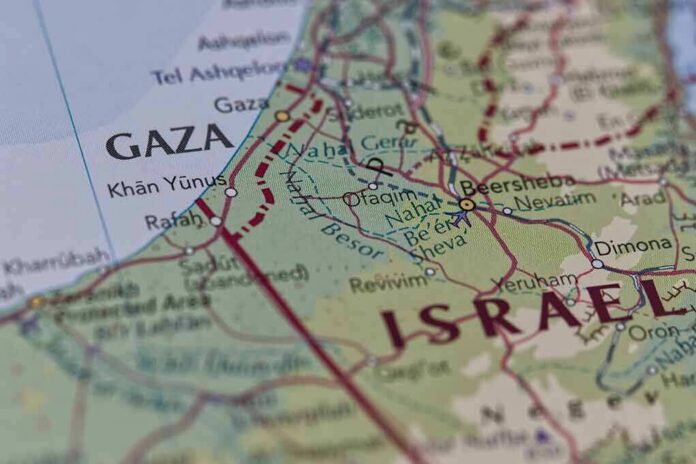
President Trump said the Board of Peace reached a deal for Hamas to give up its weapons, turning a long-running war plan into a claimed breakthrough.
Quick Take
- Trump said the Board of Peace reached a “historic agreement” for the complete disarmament of Hamas and other armed groups in Gaza.
- The Board of Peace said Hamas agreed to a detailed roadmap for the next stages of the Gaza ceasefire.
- The plan ties disarmament to phased Israeli withdrawal and a new Palestinian governing structure.
- Earlier reports described the Gaza plan as phased, with weapons surrender, tunnel demolition, and verification steps.
Trump Frames the Deal as a Major Step
Trump used Truth Social to say the Board of Peace had reached a “historic agreement” for the complete disarmament of Hamas and all other armed groups in Gaza. He called it a major milestone in his 20-point Gaza plan. ABC News reported that the Board of Peace echoed that message and said Hamas had agreed to a detailed roadmap for the next phases of the ceasefire.
The public message from Trump focused on momentum, not delay. He said the deal would help move Gaza toward a new Palestinian government and a safer future for Israel. Coverage from several outlets repeated that the plan is meant to pair disarmament with a staged shift in control, rather than a sudden handoff. That makes the announcement politically important, but also dependent on later steps that still have to be carried out.
What the Plan Says About Weapons and Withdrawal
The 20-point plan published by the BBC says Hamas and other factions will not govern Gaza, and that military and offensive infrastructure will be dismantled and not rebuilt. It also says demilitarization will be overseen by independent monitors and verified through an agreed decommissioning process. Reuters had already described a staged model in March, with weapons surrendered over months and Israeli troops withdrawing only after Gaza is confirmed clear of arms.
That phased design matters because it shows how fragile the deal could be in practice. Axios reported that U.S.-led negotiators, along with mediators from Egypt, Qatar, and Turkey, had spent months shaping a 15-point plan for disarmament and a transfer of authority. The same structure gives each side room to claim progress while leaving the hardest part, actual compliance on the ground, for later.
The Big Question Is Implementation
The clearest gap in the reporting is proof of final, public acceptance by Hamas under the exact terms Trump described. The material provided says the arrangement is conditional, phased, and still subject to verification steps. Reuters, ABC News, and the BBC all frame the process as a roadmap or next phase, not as an instantly completed disarmament. That leaves the announcement strong as a political statement, but still tied to actions that must follow.
🇺🇸 🇵🇸 #US President Donald #Trump announced the complete #disarmament of all armed groups in the #Gaza Strip, while Hamas confirmed Friday it had agreed to a deal. pic.twitter.com/4n8T3gAaYv
— Moses (@moses_kendi) July 31, 2026
For readers in the United States, the story also fits a familiar pattern in Gaza diplomacy: leaders announce a breakthrough before the full mechanics are visible. That can build hope fast, but it also raises the risk of disappointment if any phase stalls. The public record here shows a serious attempt to structure disarmament, yet it also shows how much depends on monitors, withdrawals, and follow-through that have not yet been publicly detailed.
Sources:
cbsnews.com, abcnews.com, bbc.com, npr.org, cbc.ca, euronews.com, pbs.org