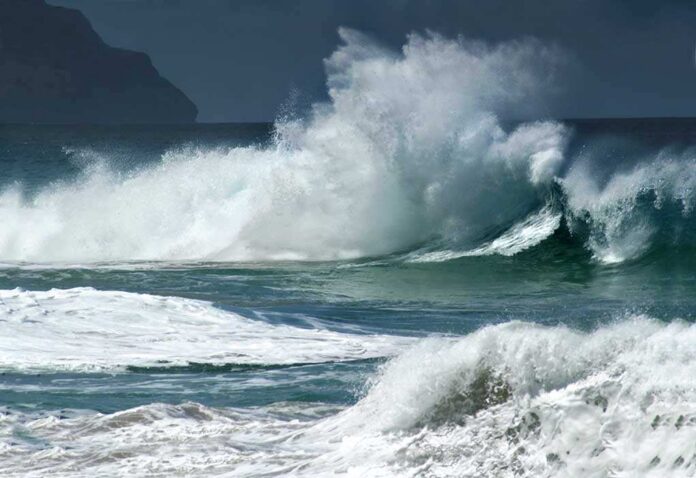
A revived “megatsunami” warning is racing across headlines, but scientists are split on whether La Palma’s volcano could actually send story-high waves to the U.S. East Coast.
Story Snapshot
- A 2001 peer-reviewed model showed a worst-case collapse at Cumbre Vieja could send large waves across the Atlantic.
- New media reports cite waves as high as 65 feet reaching the East Coast in about nine hours.
- U.S. government scientists say later studies cut far-field waves to about 3–7 feet in a worst case.
- Experts agree the scenario is possible in physics, but they dispute size, speed, and likelihood.
What the new warning claims — and where it comes from
New stories say a collapse of the west flank of Cumbre Vieja, on La Palma in Spain’s Canary Islands, could drive a “cataclysmic” wave to the United States in hours. Those pieces lean on earlier modeling by British volcanologist Bill McGuire and on a 2001 paper by Steven Ward and Simon Day. The 2001 study modeled a fast slide of up to 500 cubic kilometers and predicted large transatlantic waves under that extreme setup.
The nine-hour timing and 65-foot figure appear in secondary reporting, not the 2001 paper itself. The Ward–Day abstract instead described 10–25 meter arrival heights on American shores for a 500 cubic kilometer slide moving at 100 meters per second. That scenario has drawn wide attention for years, in part because it is vivid and easy to picture. But the model’s results depend on how big and how fast the slope fails.
What government and academic scientists say now
United States Geological Survey scientists point to ocean-floor maps that show Canary Island collapses likely happen in stages, not as one giant block. They cite newer models that reduce the maximum East Coast wave to about one to two meters, roughly three to seven feet, even in a worst case La Palma failure. Experts quoted after a recent fictional series echoed that view and said the show’s rapid, catastrophic collapse setup is not a scenario that concerns scientists today.
This pushback does not deny that landslides can make tsunamis. It argues the giant, single-slide version is unlikely under today’s geology. Later research has tested smaller or fragmented failures and found that far-field waves drop a lot with each cut in slide size or speed. That is why serious teams call for updated slope-stability tests using current data and clearer public ranges, not headline numbers alone.
How to read the science without the hype
Two facts can both be true. Physics says a fast, massive slide can launch big waves across an ocean. Field data and newer models say the real volcano likely fails in pieces and sends smaller waves, more like storm surge by the time they reach the United States. The distance between those facts is where fear, clicks, and trust live. Citizens deserve the inputs, not just the outputs: slide volume, speed, and how the coast shape changes run-up.
•The X post by @PoweredByYaH retweets a “JUST IN” alert from @remarks about a scientist warning that an unstable volcano in Spain’s Canary Islands could trigger a massive tsunami hitting the US East Coast.
•The claim centers on volcanologist Bill McGuire’s recent BBC Science… https://t.co/RJUgVVC1j3— Debbie L (@dlbambam) November 7, 2026
People on the left and right share a worry here. Government warnings often feel unclear, while media can chase the most shocking number. That gap breeds doubt. A plain update from researchers and agencies could help: show today’s monitoring, state the tested scenarios, give best, middle, and worst cases, and note how certain each is. Clear steps like that cut noise and help families plan without panic.
What matters for East Coast readers
Emergency managers plan for low-probability, high-impact events, from hurricanes to grid failures. Tsunami risk from La Palma belongs on that shelf, but not at the top. Updated models suggest the East Coast’s main risk in this scenario is dangerous currents, flooding in low areas, and port disruption if a slide occurs at the wrong time. Those are serious but manageable with alerts, drills, and hardening of key sites.
Here is the bottom line. The 2001 study showed what nature could do under an extreme slide. Recent government science and expert reviews say a giant, single-block collapse is unlikely and that far-field waves would likely be much lower. Ask leaders for transparent modeling, not spin. Demand hazard plans that match today’s evidence. That is how a free people face risk: with facts, not fear.
Sources:
nypost.com, moodys.com, onlinelibrary.wiley.com, dailymail.com, earthref.org, en.wikipedia.org