

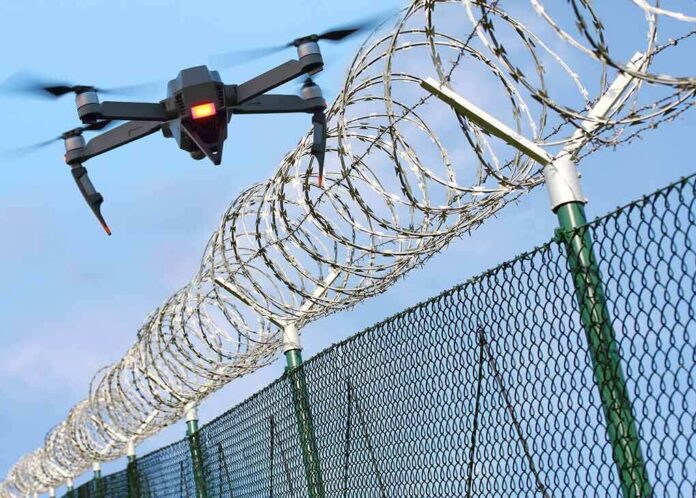
French officials say swarms of smuggling drones forced night medical helicopters to halt landings near a Strasbourg prison, turning a crime problem into a public-safety risk.
Story Snapshot
- Drug and phone deliveries by drone to French prisons have surged, straining security.
- Night helicopter landings at Strasbourg’s Hautepierre hospital were suspended for weeks due to nearby drone flights.
- Police dismantled a network tied to about 1,800 drone drops in under two months at one prison.
- Officials report thousands of prison overflights in 2025, showing rapid escalation.
What Officials Reported About Drone Smuggling
French prison authorities and local officials reported a sharp rise in drones used to drop contraband into facilities. Reporters at Le Monde cited prison-administration figures showing 600 detected overflights or attempts in 2023, up from 28 in 2022, marking a steep jump in activity. Broad coverage this year says criminals now use drones to move drugs, mobile phones, alcohol, and other small goods into prisons across the country, often at night to avoid detection.
Police and gendarmes also reported breaking up an organized network serving the Villefranche-sur-Saône prison. Coverage says investigators attributed about 1,800 deliveries over a 51-day period to that ring, highlighting an industrial scale that overwhelmed routine defenses. Separate reports describe how drones can hover near windows and drop small packages, which makes interception difficult even with patrols and cameras in place.
Health And Safety Impact Near Strasbourg Hospital
Local officials in Strasbourg said drone flights over the nearby prison disrupted night operations for emergency helicopters. The Hautepierre hospital helipad could not accept night landings for about three weeks, according to public statements, because of repeated drone incursions close to approach paths. The pause affected helicopters from medical services and civil security units, which rely on steady access to the hospital during critical care flights. Authorities said the suspension was a precaution to prevent a mid-air incident.
Courts have already issued penalties linked to these local drone disruptions. Media reports state that two young men, ages 18 and 19, received prison sentences after incidents tied to illegal drone flights over the Strasbourg facility’s airspace. Officials framed the activity as a public health concern due to the direct risk to rescue helicopters and the indirect risk from drug trafficking into detention centers. The case shows how prison smuggling can spill into broader community safety.
Why Drones Are Winning Against Old Fences
Criminals favor drones because they are cheap, quick, and hard to trace. Once a flight path is tested, repeat drops can be made with little risk to the operator on the ground. Phones, SIM cards, cannabis resin, and small tools fit easily into light payloads, and those items power prison black markets and outside contacts. Reporters and officials link the rise to a national pattern rather than a single hotspot, with multiple regions reporting sustained drone activity.
French authorities signaled the problem is accelerating. Outlets citing prison officials reported more than 5,000 overflights or attempted overflights in 2025, compared with more than 800 in 2024, suggesting both a surge in use and in detection. The scale pressures guards, who must police walls, yards, and now skies. It also stresses nearby services, like hospitals, that depend on clear and safe air corridors for emergency flights.
What This Means For Public Institutions
The Strasbourg shutdown shows how one weak link can ripple across systems. A prison’s drone problem became a hospital’s flight risk, with patients caught in the middle. That forces trade-offs: protect the sky or risk a crash. It also exposes a gap between the speed of criminal tech and the pace of government response. Many readers, left and right, see this as another sign that institutions struggle to adapt and keep basic services safe and reliable.
What To Watch Next
Lawmakers and ministers may push for stronger geofencing, radio-frequency detection, and rapid seizure rules near prisons and hospitals. Courts are already handing down sentences, but that alone may not slow organized networks. Better mapping of no-fly zones and faster data-sharing between prison staff, air safety officials, and police could reduce risk. The test is simple: can authorities secure the air above prisons without grounding rescue helicopters when lives are on the line?
Sources:
thegatewaypundit.com, euronews.com, gr.euronews.com, parsi.euronews.com, fr.euronews.com, ground.news, x.com, albeu.com, lemonde.fr