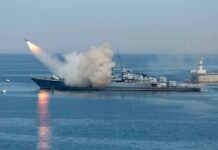
Rising gas prices and a mined choke point halfway around the world are colliding with a hard reality: America is in another Middle East war, and the mission still isn’t clearly defined.
Story Snapshot
- U.S. officials say Iran began laying roughly a dozen sea mines in the Strait of Hormuz, a key global energy artery, as the Iran war intensifies.
- President Trump warned Iran to remove the mines, and U.S. strikes reportedly destroyed Iranian mine-laying vessels—though public counts differ between 16 and 44.
- The strait remains effectively closed to tanker traffic, keeping energy markets volatile and leaving consumers exposed to higher costs.
- The Navy’s mine-clearing capacity is strained after recent decommissioning and maintenance backlogs, complicating any plan to escort ships safely.
- MAGA voters are split: many support stopping Iran’s threat, but others see a familiar slide toward open-ended conflict tied to foreign commitments.
Mines in the Strait: The Trigger and the Verification Problem
U.S. reporting describes Iranian mine activity in the Strait of Hormuz—about a dozen mines—based on intelligence assessments cited by media and officials. That detail matters because the strait carries roughly one-fifth of global oil traffic, so even limited mining can freeze commercial shipping and spike prices. Still, the public cannot independently verify the mine count, and some coverage underscores the reliance on unnamed intelligence sourcing.
President Trump responded with a public ultimatum demanding removal and signaling military consequences. The administration’s posture frames the mines as an immediate threat to international commerce and U.S. leverage in a wartime environment. For a conservative audience that’s lived through shifting intelligence narratives before, the key issue is not whether Iran is capable of mining the strait—it is—but whether Washington’s objectives, evidence disclosures, and exit strategy are concrete.
U.S. Strikes and Conflicting Vessel Counts
U.S. action quickly moved from warning to kinetic strikes on alleged mine-laying craft. One account reported 16 Iranian mine-laying vessels destroyed following the initial warning, while later Pentagon briefings referenced 44 vessels destroyed. Those numbers may reflect different time windows, target sets, or definitions of “mine-laying,” but the discrepancy is real in public reporting. When the government asks citizens to accept escalation, clarity and consistency are not optional.
Pentagon briefings also emphasized targeting intended to enable eventual escorts for commercial tankers once the mine threat is reduced. That approach is strategically understandable—mines are cheap, clearing them is slow, and escorting ships through suspected minefields risks American sailors. But it also reveals the operational dilemma: even after strikes, mines can remain in the water for days or weeks, and a single missed device can create a mass-casualty event.
Mine-Clearing Capacity Is a Hard Constraint, Not a Talking Point
The military challenge is amplified by capacity limits. Recent reporting indicates the U.S. decommissioned four dedicated mine-sweepers in September 2025, while other mine-countermeasure ships have been in maintenance abroad. That reality collides with the administration’s desire to reopen the strait quickly. Conservatives who demand competent government should focus on this: force structure decisions have consequences, and the country cannot “message” its way around physics, sea lanes, and maintenance cycles.
Former commanders and operational experts have described demining as a “big lift” that often benefits from allied participation and broad suppression of coastal threats first. Yet allied participation is not guaranteed. Public reporting points to European reluctance and Japan’s legal limits, suggesting the U.S. could end up carrying the burden largely alone. That raises the same question many voters are now asking: if the mission expands, who pays, and how does it end?
War Aims, Oversight, and the MAGA Split
Domestic politics is no longer secondary. Some MAGA voters accept the necessity of using force to keep a vital shipping lane open and deny Iran leverage. Others see an all-too-familiar path: escalating strikes, ambiguous goals, emergency funding requests, and the risk of an “endless” commitment. Democrats have criticized briefings as incoherent and warned about rebuilding risk, but the underlying concern—mission clarity—also resonates with constitutional conservatives focused on oversight and limits.
New from @JenniferJJacobs and me at @CBSNews – Amid Iran talks, Strait of Hormuz dotted with about a dozen Iranian mines, U.S. officials say. Specifically, Iranian-made Maham 3 and Maham 7 Limpet Mines. https://t.co/oWa0pkdL1e
— Jim LaPorta (@JimLaPorta) March 23, 2026
Iran, for its part, has publicly threatened extended closure and retaliation tied to attacks on infrastructure, while the U.S. has continued strikes on military-industrial targets. That tit-for-tat makes the energy pain at home feel less like an unfortunate side effect and more like a pressure point with political consequences. If Washington wants durable support, it will need to define achievable objectives, communicate evidence responsibly, and respect the public’s growing refusal to bankroll open-ended wars.
Sources:
U.S. attacks Iranian mine-laying ships near Strait of Hormuz
US targets mine-laying vessels in Strait of Hormuz amid