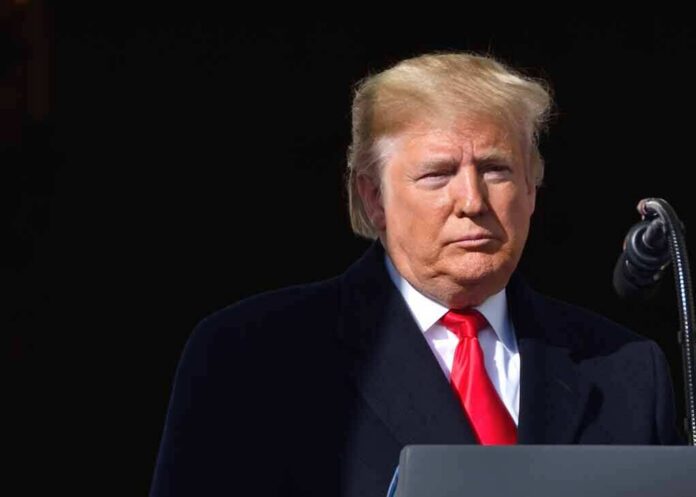
At Camp David, President Trump turned a serious warning about global war-crimes trials into a joke about himself, while his team talked about dismantling the court that claims power over Americans and U.S. allies.
Story Snapshot
- Trump told his Cabinet the International Criminal Court is not pursuing him now, but “it could happen,” drawing laughter.
- Secretary of State Marco Rubio called the court “illegitimate” for claiming power over countries, leaders, and soldiers who never joined it.
- Trump said Rubio’s campaign to “bring the court to heel” is meant to protect Israeli Prime Minister Benjamin Netanyahu and other leaders, not himself.
- The clash shows how Washington is ready to punish global institutions it sees as part of an unaccountable elite, even while many Americans feel their own government ignores them.
Trump’s Camp David Joke Masks a Serious Power Struggle
President Trump met with his Cabinet at Camp David to discuss foreign policy, including Iran, Gaza, and war-crimes investigations by the International Criminal Court. During the meeting, Secretary of State Marco Rubio warned that the court, based in The Hague, could target leaders and soldiers from countries that never signed its treaty. Trump cut in with a quip, saying, “There’s no information that they’re after me… it could happen,” which made the room laugh. He then stressed that Rubio was not trying to protect him, but Israeli Prime Minister Benjamin Netanyahu and other figures.
That light moment hid heavy stakes. Rubio argued that the court has “made themselves illegitimate” by claiming it can prosecute people from non-member countries if alleged crimes happened on the territory of a member state. He said leaders and U.S. service members could be dragged into cases many years later, even if their own governments never accepted the court’s authority. This fear fits a long pattern in U.S. politics, where officials say global bodies push past their limits and threaten national sovereignty.
Rubio’s Campaign to “Bring the Court to Heel”
Rubio told the Cabinet that the United States had started a broad campaign this month to “bring the International Criminal Court to heel,” after years of failed attempts to push reforms. He described court officials as “very arrogant” and unwilling to listen to American concerns about political cases against allies. Rubio also claimed that five countries had announced plans to leave the court since Washington began its push, suggesting that U.S. pressure was encouraging others to rethink the court’s power. Court defenders dispute that framing, but the comments show how far the administration is willing to go.
Trump echoed that message, saying the campaign was aimed at shielding Netanyahu and “various other people” who, in his view, “shouldn’t be looked at that way.” He repeated that “there is no indication that I’m one of them at this moment,” which drew more laughter in the room. The joke landed because both Trump critics and supporters know he faces many legal battles at home. Yet here he was pointing to a different kind of threat: trial by international judges who are not elected by the American people and who many voters on both the right and the left already see as part of a distant global elite.
Global Courts, National Sovereignty, and Growing Public Distrust
This fight with the International Criminal Court builds on years of tension between Washington and global legal bodies. The court’s rules allow it to investigate crimes committed on the soil of a member country, even if the accused person’s home country never joined the court. Supporters say that is normal international law and needed to stop mass killings and war crimes when local systems fail. Critics like Rubio call it a power grab that lets foreign judges reach deep into sovereign nations, including the United States.
💢 President Donald Trump clarifies that Secretary of State Marco Rubio’s campaign to “bring the International Criminal Court to heel” is intended to protect Israeli Prime Minister Benjamin Netanyahu and others facing ICC scrutiny.
Speaking at Camp David, Rubio said: “The… pic.twitter.com/poZbtbExjq
— Drop Site (@DropSiteNews) July 31, 2026
For many Americans watching from home, the scene at Camp David hits familiar nerves. Conservatives angry at “globalism” see one more foreign institution claiming the right to second-guess U.S. troops and elected leaders. Liberals worried about selective justice see a White House eager to shield powerful allies while millions of ordinary people struggle to get fairness from their own courts and government. Both groups increasingly feel that distant elites, whether in Brussels, The Hague, or Washington, make big decisions without answering to regular citizens.
Why This Moment Matters Beyond Camp David
Rubio’s talk of “systematically disabling” or even “dismantling” the International Criminal Court lines up with earlier steps by the Trump administration, including sanctions and travel bans aimed at court officials who investigate U.S. actions. These moves send a clear message: when global bodies cross lines that Washington sets, the United States will use its economic and diplomatic power to hit back. That may protect U.S. service members from politically charged cases, but it also weakens tools that victims of war and abuse around the world sometimes rely on to seek justice.
Trump’s offhand remark that the court is not coming after him “at this moment” hints at something deeper. Political leaders know that once they open the door to global accountability, they might someday walk through it themselves. In a time when many Americans believe the “deep state” and international elites protect their own, the image of top officials laughing about the court while plotting to cripple it will only strengthen the sense that powerful people are busy shielding each other, not fixing the systems that fail ordinary families.
Sources:
youtube.com, straitstimes.com, timesofisrael.com, whitehouse.gov, trumpwhitehouse.archives.gov, theguardian.com, militarytimes.com, reuters.com, aljazeera.com