
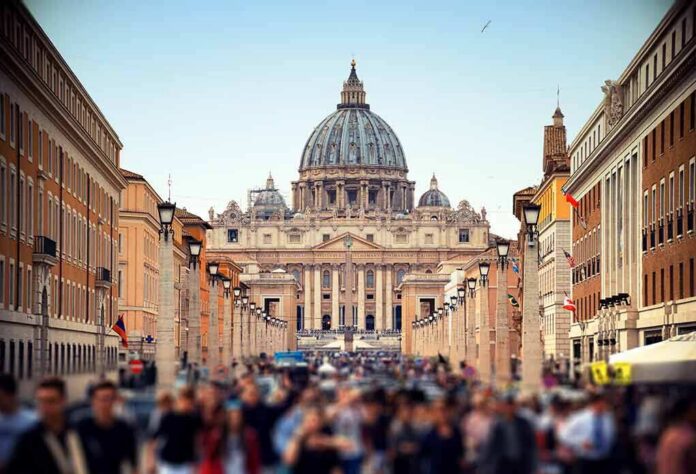
A formal Vatican letter confirmed that organizers of a traditional Latin Mass pilgrimage were refused permission to enter St. Peter’s Basilica in procession, with no public reason given.
Story Snapshot
- A Secretariat of State letter denied the group’s organized entry, prayer at the Confession, and adoration at the Altar of the Chair.
- The decision addressed a specific procession request, not a blanket ban on private entry or every Latin Mass.
- Permission had been granted in 2025 for a traditional Latin Mass at the Altar of the Chair, showing discretionary practice.
- Bishop Athanasius Schneider called the move selective and contrary to inclusion claims; the Vatican has not offered a detailed rationale.
What the Letter Says and What It Does Not Say
The letter, dated September 30, 2026, came from Archbishop Paolo Rudelli, a senior official in the Secretariat of State. He wrote to the pilgrimage chaplain that the request could not be granted. The request covered entering the basilica in procession, praying at the Confession, and adoration at the Altar of the Chair. The letter offered no reason for the denial. That silence has fueled debate over motives and rules, since the document stands alone in public view.
Reporting tied to the organizers stressed that the decision targeted the organized procession, not private entry by individuals. Accounts from the event said pilgrims were stopped from crossing St. Peter’s Square together, reinforcing that narrow focus. Those details match the letter’s scope and do not prove a universal ban on the traditional Latin Mass or ordinary access for private prayer. Still, the experience felt like a ban to many on site.
How This Differs from 2025 and Why That Matters
Coverage of the 2025 pilgrimage said a traditional Latin Mass was celebrated at the Altar of the Chair in St. Peter’s, led by Cardinal Raymond Burke. Organizers say the Secretariat of State did not authorize a similar Mass inside the basilica this year. The shift from permission in 2025 to denial in 2026 suggests a discretionary approach rather than a fixed, public rule. That contrast is driving claims of inconsistency among supporters of the pilgrimage.
The lack of a cited policy leaves outsiders guessing about criteria. No decree or basilica rule has been offered to explain when groups may process, pray at the tomb, or reserve the Altar of the Chair. Without written standards, both supporters and critics read the move through larger church disputes over the traditional Latin Mass. That vacuum invites hard feelings and spin from every side while offering the public few verifiable answers.
Reactions from Supporters and the Broader Stakes
Bishop Athanasius Schneider said the excluded pilgrims were Catholics in good standing who pray for the pope and bishops. He argued the decision undercuts church claims about inclusion and tolerance. His charge is blunt and personal, and it reflects years of rising tension over limits on the older form of the Mass. The Holy See Press Office has not issued a detailed public rationale, which leaves these criticisms mostly unanswered in the record.
The scene in Rome became a proxy for a wider fight. Supporters say the procession honors St. Peter and expresses loyalty to the Church. Skeptics inside church structures worry about events becoming signals of resistance to current liturgical policy. The 2026 denial therefore lands inside a long struggle that runs from broader permissions under Pope Benedict to tighter rules under Pope Francis. That history raises the heat on each permit decision.
What This Means for Ordinary Worshippers
Public information from the basilica affirms that people may enter to pray using established routes when open. That suggests ordinary access for private prayer remains in place. The letter and reports describe a block on a corporate procession and specific liturgical actions inside the basilica, not a shutdown of individual devotion. Still, many pilgrims experienced the group stop as a threat to their place in church life. That gap between policy terms and personal impact is the core tension.
Latin Mass pilgrims flock to Rome despite Vatican ban on Mass and procession — The Catholic Herald https://t.co/Xf25AWzGbW
— Walter (@WalterC90372390) October 26, 2026
For Americans watching from afar, the pattern feels familiar. Institutions give terse answers while people on both left and right suspect gatekeeping by elites. When leaders do not explain rules, trust erodes. Clear standards for group access, a public rationale for denials, and consistent application across communities would help lower the temperature. Until then, each closed door will look less like routine management and more like a message about who belongs.
Sources:
actssocial.com, dianemontagna.substack.com, infovaticana.com, pt.gloria.tv