
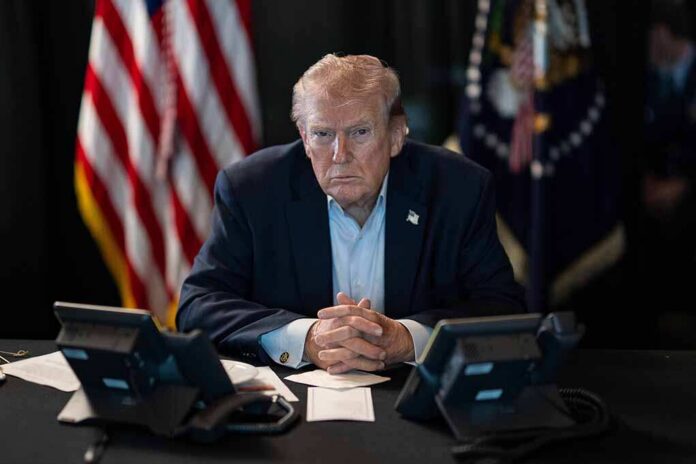
President Trump canceled plans to livestream Nidal Malik Hasan’s execution but kept the firing squad and the December 3 schedule in place.
Story Snapshot
- Trump ended the planned livestream while confirming the execution will proceed by firing squad.
- Pentagon officials had previously said the public could watch online, drawing bipartisan backlash.
- Victims’ immediate families may still attend in person, per Trump’s statement.
- The move separates the execution itself from making it a mass-media event.
What Changed: From Public Broadcast to Private Procedure
President Trump said the government will not broadcast Hasan’s execution online, reversing a plan described days earlier by Pentagon officials. He said the execution would still occur by United States Army firing squad, with no public livestream. Several outlets quoted Trump’s statement, which emphasized the execution would happen as scheduled but not be streamed. This drew a clear line between carrying out a sentence and turning it into a show for millions to watch.
The White House’s change followed days of debate over whether the government should let the public watch a death in real time. The Pentagon had told reporters the execution would be livestreamed, although officials had not identified a platform, opening legal and logistical questions. The cancellation removes those questions for now while leaving the execution plan itself in place, including the time frame and the firing squad method reported earlier.
What Still Stands: Method, Authority, and Scheduling
Defense officials previously said Defense Secretary Pete Hegseth recommended, and President Trump approved, the firing squad method. They also said the Secretary of the Army would set the exact time and place. News reports cited December 3 at Fort Hood as the scheduled date, which Trump’s announcement did not change. The administration therefore preserved the core decision to execute Hasan, while narrowing public access to viewing it in real time.
Trump’s statement allowed immediate family members of victims to attend in person, keeping witness access limited rather than universal. That approach aligns more closely with modern American practice, where executions are witnessed by a small group that can include family members and journalists, not by the general public online. The decision avoided turning a rare military execution into a live broadcast, which would have been a major break with custom.
Why It Matters: Precedent, Backlash, and Public Trust
The proposed livestream faced bipartisan criticism and opposition from retired military leaders. Reports highlighted objections to making a government killing a spectacle, which critics said echoed practices of authoritarian regimes. By canceling the broadcast, the administration addressed those concerns without changing the punishment. This choice may reduce accusations that the government uses media to shock or divide, while still signaling a tough stance on terrorism.
𝐓𝐑𝐔𝐌𝐏 𝐒𝐂𝐑𝐀𝐏𝐒 𝐋𝐈𝐕𝐄𝐒𝐓𝐑𝐄𝐀𝐌 𝐎𝐅 𝐅𝐎𝐑𝐓 𝐇𝐎𝐎𝐃 𝐓𝐄𝐑𝐑𝐎𝐑𝐈𝐒𝐓’𝐒 𝐄𝐗𝐄𝐂𝐔𝐓𝐈𝐎𝐍 — 𝐕𝐈𝐂𝐓𝐈𝐌𝐒’ 𝐅𝐀𝐌𝐈𝐋𝐈𝐄𝐒 𝐂𝐀𝐍 𝐖𝐀𝐓𝐂𝐇 𝐈𝐍 𝐏𝐄𝐑𝐒𝐎𝐍
President Trump announced on Truth Social that the firing-squad execution of Nidal Hasan will not… pic.twitter.com/AJ3zkfdyIK
— M.A. Rothman (@MichaelARothman) October 15, 2026
The pivot also reflects a deeper question: should grave state actions be carried out with solemn limits or marketed to the masses? Many Americans on the right and left worry that leaders chase headlines instead of solving real problems. Ending the livestream leans toward restraint. It keeps the focus on justice for the victims of the Fort Hood attack while avoiding a public feed that could fuel rage, trauma, or copycats. That balance will continue to test trust in federal judgment.
Sources:
facebook.com, politico.com, cnn.com, bbc.com, fox32chicago.com, cnbc.com, thehill.com, abcnews.com, apnews.com