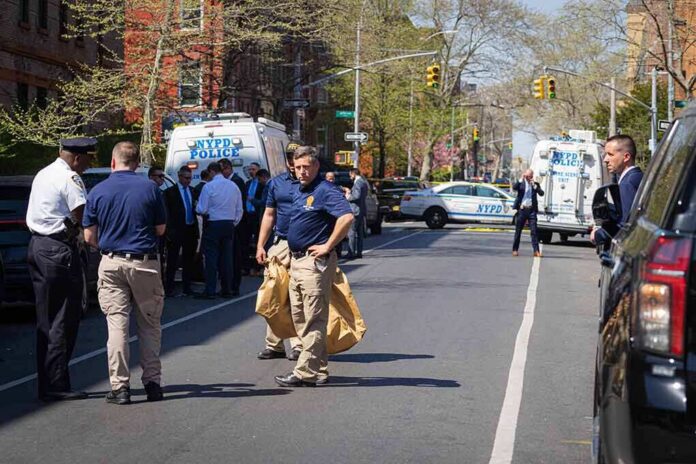
When a retired detective is charged as a node in a narcotics pipeline, the damage runs beyond the alleged drug sales; it strikes at the credibility that law enforcement depends on to dismantle those very networks.
At a Glance
- Prosecutors charged four defendants with running a drug conduit from Upper Manhattan to Staten Island, supplying fentanyl, heroin, crack, cocaine, and counterfeit pills.
- The case stems from a wiretap-led investigation by New York City’s Special Narcotics Prosecutor and NYPD, followed by coordinated searches and arrests.
- One defendant is a retired NYPD detective; searches linked to the probe recovered more than a dozen unlicensed firearms alongside narcotics evidence, according to authorities.
- The alleged structure and methods track with prior cases where current or former officers leveraged know-how or credibility to abet trafficking—behavior that is institutionally plausible but never presumed.
What prosecutors say happened and why it matters
New York City’s Special Narcotics Prosecutor announced charges against four people accused of operating a narcotics pipeline from Washington Heights into Staten Island’s street market. Authorities identified the group’s alleged leader, Shanta Sawyer, and three co-defendants: Sophia Abinacer, Michael Giordano, and retired NYPD detective Philip (Phil) Pietrunti. The complaint describes a multi-borough conspiracy distributing fentanyl, heroin, crack cocaine, cocaine, and counterfeit pills to dozens of Staten Island buyers—a portfolio aligned with the city’s poly-drug street economy. The arrests followed a wiretap investigation and coordinated searches that, according to the office, seized narcotics evidence and more than a dozen unlicensed firearms from locations tied to the defendants.
The public impact here is twofold. First, the alleged flow—from a resilient Upper Manhattan wholesale corridor to neighborhood retail on Staten Island—reflects how New York’s cross-borough distribution has adapted to enforcement pressure by diversifying supply lines and products. Second, the presence of a retired detective among the accused raises the stakes: institutional knowledge, if misused, can help insulate a street operation from the very tactics used to detect and disrupt it. That allegation underwrites the intensity of the response—from wiretaps to multi-location searches—designed to collapse the network’s capacity in one move.
How the case was built: tools, timing, and tactical choices
Wiretaps remain the most powerful tool for mapping modern drug conspiracies because they reconstruct not just transactions but the architecture—who sources, who transports, who handles cash, who fields customer complaints. According to reporting on the complaint, investigators initiated targeted intercepts months before the takedown, using the conversations to connect roles across borough lines and time their warrants when the evidence was most likely to be present. In New York’s narcotics playbook, that cadence is familiar: tap phones to capture operational rhythm; corroborate with surveillance, buys, or package seizures; hit stash locations and key residences on the same day to prevent evidence migration; then present an integrated case tying product, proceeds, and firearms to the conspiracy’s command-and-control.
The firearms dimension matters. Narcotics conspiracies routinely employ guns to protect stash houses, settle disputes, and intimidate rivals or delinquent buyers. The Special Narcotics Prosecutor’s release stated that more than a dozen unlicensed firearms were recovered during searches linked to this investigation—a number consistent with a distribution crew securing multiple premises and vehicles, not a lone dealer’s handgun. Separate local reporting details that a Great Kills residence associated with the retired detective contained numerous unlicensed firearms, including rifles, underscoring why prosecutors coupled drug charges with weapons counts where available.
The defendants, roles alleged, and what is and is not established
Authorities have described Sawyer as the organizer, coordinating with Abinacer, Giordano, and Pietrunti to move product and meet customer demand across Staten Island neighborhoods. Press accounts attribute Staten Island DA and NYPD statements identifying Pietrunti as a retired detective who served in the Emergency Service Unit, a detail the defense will surely contest if prosecutors propose any inference from training to culpability; titles do not prove conduct, but they do explain why the allegation commands attention. As in any criminal case, charges are allegations; the burden remains with the government at trial.
What the public can draw from the record to date is narrow but consequential: a wiretap-backed investigation; four named defendants charged; and searches yielding narcotics evidence and more than a dozen unlicensed firearms, according to the Special Narcotics Prosecutor’s official release. Those are the load-bearing facts of the case’s posture today.
Why a retired officer in a drug case is institutionally plausible
While rare relative to the universe of drug defendants, law-enforcement-linked trafficking conspiracies are not hypothetical. Federal prosecutions have documented current and former officers who supplied intelligence to protect loads, escorted purported drug shipments for cash, or moved product themselves. Examples include the convictions of a former Houston Police officer for cocaine-trafficking conspiracy tied to a cartel supply line, the sentencing of a former Baltimore officer on drug and firearms counts after attempting to facilitate fentanyl distribution, and multi-defendant stings where sworn officers agreed to guard what they believed were narcotics convoys—cases that turned on undercover operations and recordings, not hearsay.
Those analogues do not prejudge these defendants; each case rises or falls on its own evidence. They do, however, rebut the notion that such conduct is institutionally implausible. Training that sharpens threat perception, surveillance awareness, and search-warrant literacy can also, in bad hands, harden a conspiracy against exactly the tactics used here—hence prosecutors’ reliance on wiretaps and coordinated raids to outpace any countermeasures.
Ex-NYPD detective among 4 busted in massive NYC drug ringhttps://t.co/NW8XfCBddh
— BREAKING NEWZ Alert (@MustReadNewz) November 10, 2026
The Washington Heights–to–Staten Island corridor: supply, demand, and enforcement
New York’s Upper Manhattan markets have long functioned as wholesale and mid-level hubs, with Washington Heights historically central to cocaine’s distribution and, in the fentanyl era, a broader poly-drug inventory. Staten Island’s demand picture is different in scale but not in complexity: overlapping use of fentanyl-adulterated opioids, crack, and counterfeit pills creates steady retail turnover and high overdose risk. A cross-borough pipeline exploits geographic proximity and price differentials; the risk calculus for sellers hinges on whether they can keep product moving without drawing attention across bridges and ferries that concentrate surveillance. Tapping phones compresses that advantage—intercepts capture ordering cycles and rendezvous points, allowing enforcement to time seizures when product and proceeds converge.
What to watch next: litigation posture and public safety stakes
Expect early motions to test the sufficiency and scope of the wiretaps and to challenge firearm attributions to specific defendants. The prosecution’s leverage will track how cleanly it can map seized guns, drugs, and cash to roles documented on the calls and any corroborating surveillance. If the government’s evidence holds together, plea negotiations often resolve mid-level roles first, narrowing trial issues to leadership, firearms enhancements, and drug-weight accountability.
For Staten Island, the immediate question is whether this takedown meaningfully dents retail supply or merely displaces it. Network arrests can drive a transient lull; the durable impact comes from decapitating organizers while seizing enough proceeds, product, and weapons to make replacement costly. The recovery of more than a dozen unlicensed firearms alongside narcotics evidence is a signal that, at minimum, this crew had embedded security—removing those guns from circulation is a public safety gain on its own terms.
Sources:
nypost.com, dnyuz.com, nydailynews.com, snpnyc.org, linkedin.com, statenislandda.org, silive.com, justice.gov, atf.gov