

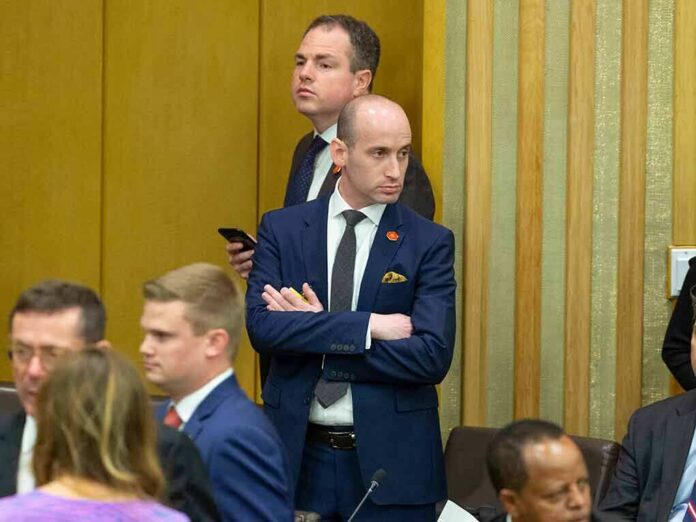
When a senior White House adviser sheds recusals, it is not a footnote; it is a functional change in who gets to steer consequential policy. According to published reporting, Stephen Miller is no longer recused from space and artificial-intelligence matters after his wife, Katie Miller, exited her SpaceX role, sold her stock, forfeited unvested equity, and ended a separate Paramount podcast arrangement—steps the White House says remove the conflicts that sidelined him from those files.
At a Glance
- Stephen Miller’s recusals from space and AI policy have ended, per a White House statement quoted in contemporaneous reporting.
- Katie Miller reportedly left SpaceX, sold her SpaceX shares, and forfeited unvested equity, addressing the basis for the original conflicts.
- She also reportedly terminated a Paramount-related podcast contract cited in earlier recusal decisions.
- These moves track with standard federal ethics remedies—recusal followed by divestiture or resignation to permit full participation.
What Changed: The specific steps that cleared the conflicts
The underlying facts, as reported, are straightforward. Katie Miller severed her employment with SpaceX, sold her SpaceX stock, and relinquished rights to unvested equity. In parallel, she ended a planned Paramount podcast deal. Those interests were the cited reasons Stephen Miller had previously recused from AI and space policy while also avoiding Paramount-related policy questions; once removed, a White House official said flatly that “Stephen Miller is no longer subject to any recusals and may fully participate in all meetings and policy matters.” Together, the divestiture and contract termination erase the imputed financial interests that triggered his earlier stand-downs.
Mechanically, the sequence is conventional. Executive-branch ethics rules treat a spouse’s financial interests as imputed to the employee for conflict analysis; one common route is to recuse while the interest exists and then to regain eligibility once the interest is eliminated through sale, resignation, or contract termination. The Office of Government Ethics (OGE) trains agencies to deploy that ladder of remedies case-by-case under 18 U.S.C. § 208 and related standards.
How Federal Ethics Resolves Spousal Conflicts
Conflicts in the executive branch are managed, not mythologized. The statute that governs personal financial conflicts—18 U.S.C. § 208—prohibits an employee from participating personally and substantially in a particular matter that would have a direct and predictable effect on their financial interests or those imputed to them, including a spouse’s. The law does not permanently sideline officials with working spouses; it drives a practical decision tree: recuse, divest, resign, reassign, or, in rare instances, obtain a waiver. OGE guidance underscores that spousal employment conflicts are typically addressed through recusal or elimination of the interest rather than waivers involving a spouse’s employment, which are “rarely justifiable”.
In practice, an agency ethics office or the White House counsel’s office identifies the conflict, documents the recusal, and, if appropriate, sets conditions for lifting it after a transaction. Nominee and appointee guidance explicitly anticipates sales of stock, forfeiture of unvested employer equity, resignations from conflicting positions, or termination of contracts; ethics officials then certify compliance. This is the standard playbook, not an improvisation.
The Miller Timeline in Context
Earlier this year, Stephen Miller stepped back from policy involving AI when Katie Miller held a consulting arrangement with xAI; he likewise recused from space policy when SpaceX acquired xAI. Paramount-related matters also fell behind a recusal line because of her podcast plans. Those call sheets match the ethics framework just described: as long as a spouse’s financial interests are live and could be directly and predictably affected by the official’s actions, the official avoids participation.
The new reporting says Katie Miller’s SpaceX relationship ended, her equity exposure was removed, and the Paramount deal was terminated, which in turn led the White House to declare Stephen Miller free of those recusals. The cause-and-effect logic here is textbook—remove the imputed interest, remove the legal barrier to participation. The description aligns with the outcome agencies regularly pursue to restore an official’s full portfolio without the cloud of a recusal.
🚨 REMOVE THE CONFLICTS: Katie Miller reportedly left SpaceX, sold her shares and ended her Paramount contract, allowing Stephen Miller's recusals on related issues to be lifted.
GOOD. If private business interests interfere with public duties, clear them out of the way.
That's… https://t.co/gq4UK7tze8
— Gunther Eagleman™ (@GuntherEagleman) November 10, 2026
Why This Matters for Policy Substance
Space and AI are not boutique topics; they are cross-cutting policy arenas with national security, industrial policy, and regulatory architecture at stake. Recusal limits who is in the room to shape executive orders, interagency directives, and negotiations with industry. Lifting recusals puts Stephen Miller back into the deliberative stream on issues ranging from civil-military space integration and launch market competition to algorithmic accountability, federal AI procurement, and the government’s posture toward frontier models and dual-use research. In any White House, personnel is policy; eligibility to participate determines which ideas and risk tolerances ascend.
How Ethics Decisions Are Made—and Recorded
The OGE framework delegates the day-to-day conflict resolution to agency ethics officials and counsel offices. They document recusal obligations, establish compliance steps, and, when an official completes divestitures or resignations, certify that the barriers have been removed. The process can include ethics agreement commitments at appointment and subsequent certifications that divestitures were completed by a deadline—often with restrictions on reacquisition of the asset during government service. This system is designed to be durable and predictable across administrations precisely because complex families and portfolios are common among senior appointees.
Spousal conflicts involving large technology and media firms are neither novel nor inherently disqualifying. The system’s legitimacy rests on two pillars: front-end recusals that prevent participation while a conflict exists, and back-end remedies—sale, resignation, forfeiture, contract termination—that remove the conflict so the official can return to duty. On the facts reported here and the White House’s on-the-record conclusion, Stephen Miller has moved from the first pillar to the second.
What to Watch as Policy Engagement Resumes
Restored eligibility is not the same as resolved policy debates. The real contests ahead are substantive: how the administration calibrates AI risk mitigation against innovation incentives; how it treats commercial space as a strategic sector while preserving competitive neutrality; and how the White House coordinates with independent agencies on data governance, export controls, and national security reviews. With recusals lifted, Stephen Miller can now help define those choices directly—an institutional shift with practical consequences for timelines, emphasis, and outcomes.
Sources:
theatlantic.com, thenightly.com.au, politicalwire.com, article.wn.com, edition.cnn.com, congress.gov, oge.gov