

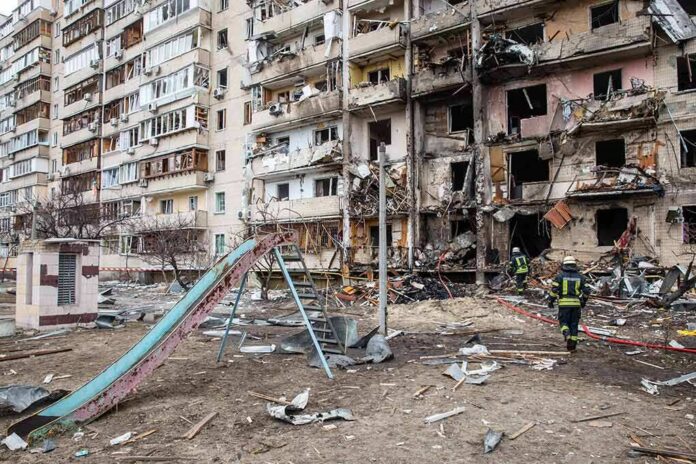
Russia’s record-breaking missile strike on Kyiv shows how modern war and distant elites can still put ordinary civilians directly in the crosshairs.
Story Snapshot
- Russia fired about forty ballistic missiles at Kyiv in the largest such strike of the war, killing at least one person and injuring more than a dozen.
- Ukrainian officials say air defenses shot down 18 missiles, but more than twenty still hit homes, offices, warehouses, and transport sites across five city districts.
- Russian media claim the targets were military factories and fuel depots, while images from Kyiv show burned apartment blocks, a damaged metro station, and civilians fleeing.
- The attack fits a wider pattern of huge “salvo” strikes that test air defenses, strain Western support, and raise hard questions about who is really protected by today’s global power structure.
What Actually Happened Over Kyiv
Ukrainian officials report that early Sunday Russia launched about forty ballistic missiles at Kyiv in under an hour, describing it as the largest such barrage since the full-scale invasion began. The Ukrainian Air Force says defenses shot down 18 of 41 missiles, yet 23 missiles and 10 drones still hit 20 locations in and around the capital. President Volodymyr Zelenskyy wrote that at least one person was killed and 16 injured, while city officials initially reported 15 wounded.
Emergency services document fires and blast damage across at least five districts, including Solomianskyi, Shevchenkivskyi, Dniprovskyi, Desnianskyi, and Sviatoshynskyi. Residential buildings, offices, industrial sites, vehicles, and a dormitory were hit, and rescue workers pulled people from burning homes and apartments. Images from Kyiv show a large crater in a residential area and charred facades on nearby buildings, underscoring how closely packed urban neighborhoods bear the brunt of these strikes.
Competing Stories About the Targets
Western and Ukrainian outlets frame the strike as a massive and largely indiscriminate attack on a city of millions, stressing burned homes, destroyed warehouses, and a damaged metro station vestibule that forced trains to skip a key stop. Ukrainian police and firefighters on the ground talk about rescuing civilians from collapsed or burning buildings rather than about military bases. For families watching from bomb shelters, the practical reality is simple: their homes, schools, and workplaces are now part of the battlefield.
Russian state messaging paints a different picture, claiming the missiles struck “military-industrial enterprises, logistics hubs, and fuel infrastructure used by Kyiv’s forces.” That language suggests a clean, targeted operation against war production, not ordinary citizens. However, without independent satellite data or open forensic work on debris, the public is left choosing between two narratives, each coming from governments and media ecosystems that many Americans already distrust.
How This Fits the New “Salvo War” Pattern
Security researchers note that this attack follows a broader “salvo war” trend, in which Russia now uses very large waves of missiles and drones meant to overwhelm defenses through sheer numbers. One study finds average strike size has jumped from about 100 weapons in 2022 to nearly 300 by 2025, with big attacks coming days apart instead of once a month. Recent barrages against Kyiv have included hundreds of drones and dozens of missiles in a single night, making it harder to protect every power station, bridge, and apartment block.
These mass strikes also serve political goals. Moscow regularly frames them as payback for Ukrainian hits on Russian energy sites, casting itself as the side “responding” rather than “starting.” Kyiv, in turn, highlights each “largest ever” attack to argue that current air defenses are not enough and to press Western capitals for more interceptors. Ordinary Ukrainians thus live under constant bombardment while distant leaders trade statements, and Western taxpayers see another open-ended demand for weapons with little sign of a real peace plan.
Why Americans Across the Spectrum Feel This Matters
For many Americans, this strike echoes a familiar frustration: powerful states engage in long wars, while regular people pay the price and elites rarely seem accountable. Conservatives who already worry about globalist entanglements and endless foreign spending see yet another example of U.S. and NATO defense chains being stretched thin to manage a war far from home. Liberals concerned about human rights and widening inequality see civilians once again trapped while major powers treat whole cities as chess pieces on a global board.
🧵 THE WAR OF THE CITIES, AGAIN
A source in Moscow defense circles tells The New Yorker the next phase of the war may resemble the Iran–Iraq “War of the Cities” of the 1980s — with one difference. Ukraine has lived under mass strikes for four years. Russia is confronting them… pic.twitter.com/pPpINmDjie
— big ben (@alternative_war) July 19, 2026
Both sides share a common worry: does any of this make ordinary Americans, or ordinary Ukrainians, safer? The blast patterns in Kyiv suggest that even with advanced air defenses, a determined attacker can still punch through and hit neighborhoods, metro stations, and warehouses storing medical or aid supplies. That raises tough questions about whether today’s security systems mainly protect political leaders and defense contractors while leaving families and local communities to absorb the real shock of modern war.
Sources:
theguardian.com, euromaidanpress.com, youtube.com, instagram.com, united24media.com, news.un.org, cnn.com, reuters.com, csis.org