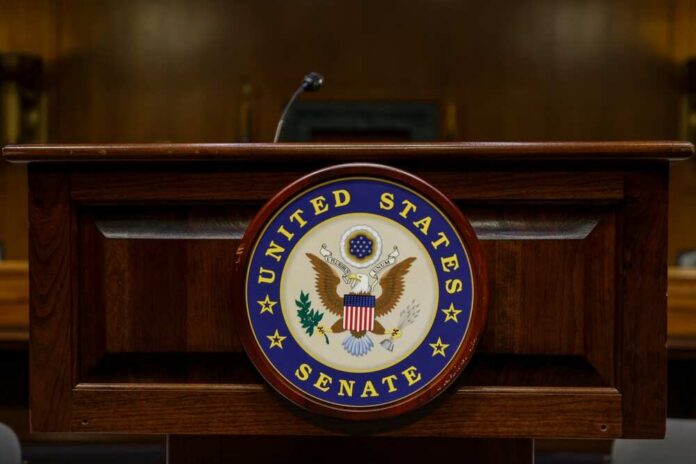
Trump’s war powers clash with Senate Republicans exposed a raw fight over who controls American military action.
Quick Take
- The Senate passed a **50-48** war powers resolution aimed at Iran.
- Four Republicans joined Democrats: Rand Paul, Susan Collins, Lisa Murkowski, and Bill Cassidy.
- The measure is the first of its kind to pass both chambers since 1973.
- The White House says the resolution is symbolic and can be ignored.
Senate Rebuke Puts War Powers Fight Back in Focus
The Senate voted 50-48 on Tuesday to back a House-passed war powers resolution on Iran, handing President Trump a sharp rebuke from lawmakers who say Congress must approve continued military action.[6] Reuters said the vote marked the first time since the War Powers Act of 1973 that both chambers approved a concurrent resolution aimed at ending hostilities.[6] The fight now centers on whether Congress can still check a president who claims the conflict already ended.
Four Republican senators broke with most of their party and voted yes: Rand Paul, Susan Collins, Lisa Murkowski, and Bill Cassidy.[4] BBC News said the House passed the same measure earlier, making this the first successful two-chamber War Powers Resolution of its kind since 1973.[4] Supporters say that matters because the Constitution gives Congress the power to declare war, and they argue the White House cannot keep using force without clear approval.
Why Supporters Say the Vote Matters
Senator Tim Kaine has framed the issue as a basic constitutional guardrail, not a partisan stunt. The resolution orders U.S. forces out of hostilities against Iran unless Congress authorizes the mission or the president acts to stop an imminent attack.[2] Al Jazeera reported that the measure includes a narrow defense exception, showing it does not block every military response. It seeks to keep force limited unless Congress signs off first.
Backers also point to the War Powers law’s 60-day limit for military action without congressional approval.[4] BBC News reported that U.S. strikes began on February 28, while the Trump administration says an April ceasefire reset the clock.[4] That dispute matters because it changes how each side reads the law. If the original timeline holds, supporters say the administration crossed the line long ago. If the ceasefire reset it, the White House has a stronger case.
White House Dismissal Turns Up the Heat
The White House brushed off the resolution as nonbinding and politically meaningless. Reuters, BBC News, and Al Jazeera all described it as symbolic and not law because it is a concurrent resolution that does not require the president’s signature.[2][4][6] That gives Trump a strong practical advantage, even after the vote. He can reject the message, keep the policy, and force Congress to decide whether it will do more than issue warnings.
US Senate passes war powers resolution challenging Trump’s Iran war authority https://t.co/3BOsAI1aiD
— suzann tucker (@bajasuz) June 24, 2026
The administration also argues there are no hostilities left to end because the ceasefire took effect on April 7.[5] That claim creates the biggest factual fight in the story. If fighting truly ended, then the resolution targets a conflict the White House says no longer exists. If U.S. forces remain tied to active hostilities, then Congress can argue the president is sidestepping the law and ignoring its own war powers role.
What Comes Next
The immediate result is political pressure, not an enforceable command. Reuters reported that the resolution does not carry the force of law, and the Supreme Court has said such measures need proper legal presentation to bind the president.[6] Even so, the vote gives critics of the Iran mission a clear record of opposition and a new constitutional argument. It also puts vulnerable Republicans in a difficult spot as they choose between party loyalty and Congress’s war powers.
For conservative readers, the deeper issue is simple: the Constitution was built to keep one person from dragging the country into war alone. Supporters of the resolution say that principle still matters, even if the White House shrugs it off. Opponents say the president already ended the conflict and that Congress is trying to relive a fight the ceasefire settled.[4][5] That legal and political split is not going away soon.
Sources:
[2] Web – The US Senate has voted 50-48 to pause the war on Iran. Four …
[4] Web – US Senate votes 50-48 to curb Trump’s Iran war powers, with four …
[5] Web – Congress passes war powers measure for first time, breaking … – BBC
[6] Web – Congress passes war powers resolution, offering rare rebuke of Trump