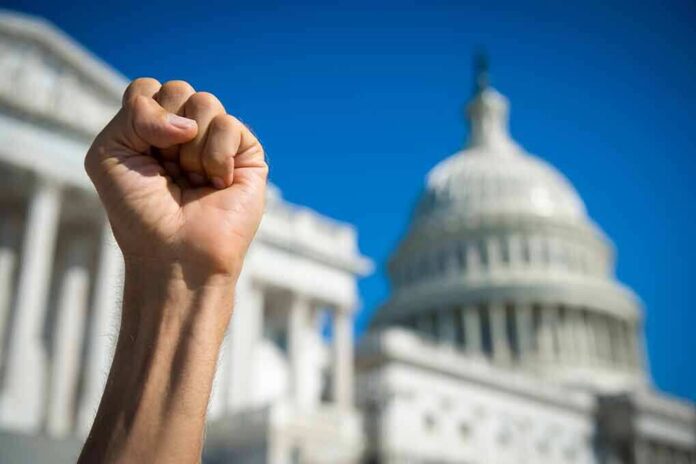
Uyghur activists filled Washington’s streets as President Trump hosted China’s Xi Jinping, demanding human-rights accountability now.
Story Highlights
- Uyghur groups led protests in Washington during the Trump–Xi summit, pressing action on abuses in Xinjiang.
- Advocacy coalitions also included Tibetan, Hong Kong, and Chinese democracy activists with shared but distinct demands.
- The United States has formally cited atrocity crimes against Uyghurs, raising pressure for concrete steps at the summit.
- White House focus on detainees may not cover wider human-rights issues, according to reporting.
Protesters Press Trump to Challenge Xi on Rights Abuses
Uyghur activists marched near the White House and the Capitol as President Trump welcomed Chinese leader Xi Jinping for talks. Demonstrators called on Trump to press Xi on detentions, surveillance, and repression in Xinjiang. Footage shared by a major news outlet on social media showed Uyghur flags and signs urging action, underscoring a clear ask: put human rights on the meeting agenda. Advocacy leaders framed the summit as a decision point, not just a photo op, for United States policy.
Radio Free Asia reported that Uyghur and Tibetan groups saw Xi’s visit as a moment to move from words to results, citing earlier United States findings on atrocities against Uyghurs. Their message aimed at both leaders: Beijing should end mass abuses, and Washington should back words with leverage. Protest organizers scheduled rallies across several days near key government sites to keep public focus on rights while motorcades and meetings drew global attention.
Coalition on the Streets, Distinct Demands at Stake
Protests featured a broad coalition. Tibetan, Hong Kong, Chinese democracy, and Falun Gong communities joined Uyghur groups in coordinated events. Their goals overlapped on free speech, religion, and due process, yet each group raised specific cases and policies linked to its community. This pattern recurs during Xi’s overseas trips and high-profile summits. Large gatherings often get framed as generic “anti-China” protests, but the demands differ in detail and remedy.
Human-rights organizations and United States reports have documented severe abuses against Uyghurs, including mass detention, forced labor, and family separation. The United States government’s annual human-rights report states that genocide and crimes against humanity occurred against predominantly Muslim Uyghurs in Xinjiang. These findings carry legal and moral weight. They also raise expectations that any high-level meeting should address prisoner releases, access for monitors, and clear benchmarks tied to future engagement.
Policy Signals: What the Summit May and May Not Cover
Reporting ahead of the summit indicated President Trump planned to raise specific detainee cases with Xi. It remained unclear whether broader systemic concerns, including Xinjiang policies and pressure on diaspora communities, would get the same attention. Lawmakers from both parties urged a fuller human-rights agenda for the meetings, linking it to long-standing concerns over repression in Tibet, Xinjiang, and Hong Kong, and the treatment of dissidents. That bipartisan push reflects durable public concern beyond day-to-day politics.
WATCH: UYGHUR ACTIVISTS PROTEST XI JINPING’S VISIT TO WASHINGTON
Uyghur activists took to the streets of Washington as President Trump hosted Chinese President Xi Jinping for a closely watched summit. Demonstrators protested Beijing’s human rights record and urged Trump to press… pic.twitter.com/Ao3v1XaOQ2
— Sergeant News Network (@sgtnewsnetwork) September 24, 2026
Rights groups argue that narrow talks risk treating abuses as side issues rather than core tests for ties with Beijing. They point to past summits where trade and security crowded out human rights. Advocates say clear steps—naming prisoners, setting deadlines, and tying progress to future deals—are the only way to shift incentives. For many Americans across the spectrum, this debate echoes a deeper worry: powerful governments cut deals while ordinary people pay the price.
What Matters for Americans Watching at Home
For citizens who feel the federal government talks tough but delivers little, this moment is a gauge of priorities. Protesters asked the administration to match strong words with action that defends basic freedoms. Supporters of a tougher China policy see human rights as part of national strength. Advocates on the left and right also warn that ignoring abuses abroad weakens moral standing at home. The test now is whether summit headlines translate into measurable outcomes for people at risk.
Sources:
facebook.com, rfa.org, thediplomat.com, thehill.com, visiontimes.com