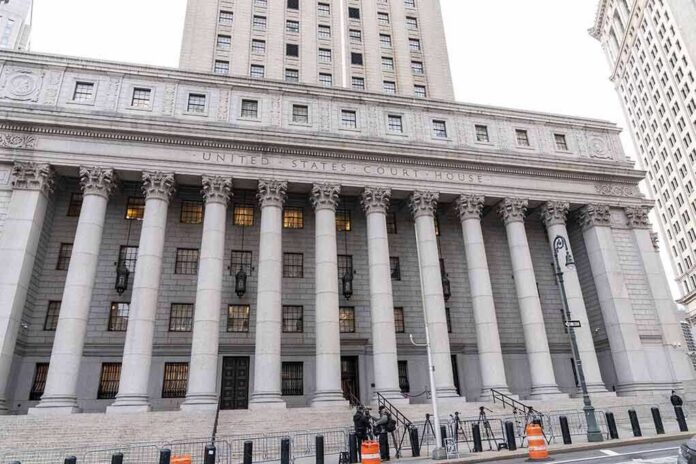
A federal judge said the newly released Epstein files do not help Ghislaine Maxwell, and instead make her look more guilty.
Story Snapshot
- Judge Paul Engelmayer rejected Maxwell’s bid to overturn her convictions, calling her claims meritless.
- The judge said the “new” Epstein records were largely irrelevant and, where relevant, incriminating.
- Another judge unsealed Epstein-related materials under a 2025 transparency law, overruling Maxwell’s secrecy push.
- The ruling signals how courts treat transparency releases as public records, not proof to reopen convictions.
Judge’s Ruling on Maxwell’s “New Evidence” Claim
On August 25, 2026, U.S. District Judge Paul Engelmayer refused to overturn Ghislaine Maxwell’s sex trafficking convictions. He wrote that her claims were “all meritless” and “largely irrelevant” to any legal error. He added that, where the new materials mattered, they did not clear her. They pointed the other way and “incriminated” her or backed the rulings she attacked. The decision rejected her attempt to use a recent flood of Epstein-related records to win release from prison.
Maxwell had argued that newly disclosed files supported her habeas petition. She claimed the government broke constitutional rules and that the post-trial record showed a “miscarriage of justice.” Judge Engelmayer disagreed. He found her theories rested on speculation, distortions, or falsehoods, not on solid, material facts that would change the outcome. The court also denied a basis for appeal, underscoring that her points had already failed on earlier review efforts or did not meet strict post-conviction standards.
What Triggered the Epstein Records Release
Congress passed the Epstein Files Transparency Act in 2025. The law ordered the Attorney General to release all unclassified records tied to Jeffrey Epstein and Ghislaine Maxwell within set deadlines. The goal was broad public access, with limited redactions to protect victims. The law created a path for large-scale disclosure but did not decide guilt or innocence in Maxwell’s case. Courts and the Justice Department have been processing disclosures under that statute.
On August 11, 2026, Judge Loretta Preska ordered unsealing of certain Epstein-linked materials in New York. She rejected Maxwell’s objections and said the transparency law set the rules for release. That order addressed what the public can see, not whether Maxwell received a fair trial. It kept victim-protecting redactions in place while allowing many records to enter the public domain. The unsealing expanded the file room; it did not reopen the verdict.
Why Transparency Does Not Equal Exoneration
Courts treat “newly released” and “newly exculpatory” as different things. Post-conviction relief requires more than curiosity or volume. Judges look for proof that is both genuinely new in the legal sense and likely to change the result. Transparency releases focus on access, history, and oversight, not on defense strategy. That is why a document dump can make headlines yet still fail in court. Judge Engelmayer’s ruling tracks that pattern.
🚨 UPDATE: Ghislaine Maxwell Appeal Rejected By US Judge
A US judge has rejected Ghislaine Maxwell’s latest attempt to overturn her sex trafficking conviction, calling her appeal “frivolous” and “meritless.”
Maxwell, 64, is currently serving a 20-year prison sentence after… pic.twitter.com/nXhWUsBYkF
— Emmanuel – Big Tech & AI Investor (@EmmanuelInvest) August 25, 2026
Some released materials also reduced their own punch. Reporting noted that parts of the cache included items already known from Maxwell’s case, like flight logs and evidence lists. If a record was public before or in the trial files, it is hard to call it “new,” and even harder to show it would flip a jury’s view years later. That undercuts claims that the latest wave of disclosures alone proves a wrongful conviction.
What This Means for Public Trust
Americans across the spectrum doubt that the powerful face equal justice. Many see secrecy as a shield for elites. This case shows a split reality. Congress forced sunlight on a dark chapter through a transparency law, which is a win for public access. But courts still require strong, targeted proof to disturb a jury’s verdict. That higher bar protects due process but can frustrate people who expect big disclosures to expose and fix deeper wrongs.
The takeaway is sobering. The government can open files and still leave the public with questions about who knew what, and when. At the same time, judges keep the courtroom focused on evidence that changes outcomes, not on broad suspicion. That gap is where distrust grows. People see millions of pages but few consequences for networks of influence. Maxwell lost this round because the documents did not meet strict legal tests. The trust problem remains outside the courthouse.
Sources:
abc7news.com, abcnews.go.com, aol.com, apnews.com