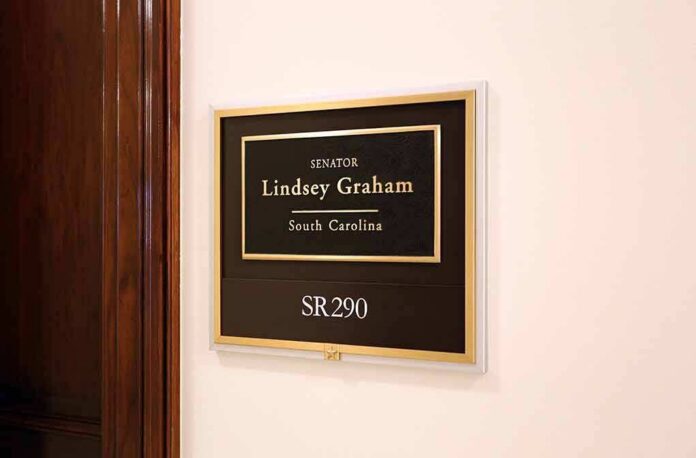
Senator Lindsey Graham died suddenly on July 11, 2026, and Iranian state television celebrated his death — but no autopsy, no toxicology report, and no official investigation has confirmed anything other than a “brief and sudden illness.”
Story Snapshot
- Graham, 71, died on the evening of July 11, 2026, after what his office called a “brief and sudden illness,” with no cause of death publicly disclosed.
- Emergency workers responded to a cardiac arrest call at Graham’s home, according to NBC News — a detail consistent with natural causes.
- Iranian state television celebrated his death, but no autopsy, toxicology results, or official investigation has been released to support or rule out foul play.
- Claims of FBI investigation or foreign poisoning come from a single partisan outlet and are not confirmed by any government agency, mainstream news organization, or named official.
What We Know About Graham’s Death
Senator Lindsey Graham of South Carolina died on the evening of July 11, 2026. He was 71. His office posted a statement saying he passed from a “brief and sudden illness” and asked for privacy. No cause of death was named. Emergency workers had responded to a cardiac arrest call at his home, NBC News reported. Graham had been active just days before, posting on social media and meeting with Ukrainian President Zelenskyy in Kyiv.
Graham was one of the most prominent voices in the Senate on foreign policy. He pushed hard for U.S. military pressure on Iran and Russia. He was also a close ally of President Trump. Trump mourned him on Truth Social, calling him a “true American patriot.” Leaders from Israel, Ukraine, and across the U.S. also offered condolences. No one in an official capacity suggested foul play.
Iranian TV Reaction and the Poisoning Claim
One partisan outlet, The Gateway Pundit, reported that Iranian state television celebrated Graham’s death and said he had been “sent to hell.” That claim has not been confirmed by any mainstream news organization, and no video or transcript from Iranian state media has been independently verified. The report spread quickly on social media, where some users pointed out that Iran had previously threatened Graham over his support for military action against the country.
The leap from “Iran celebrated his death” to “Iran killed him” is not supported by any evidence in the public record. No autopsy report has been released. No toxicology results are available. The Federal Bureau of Investigation (FBI) has made no public statement about an investigation. Neither has the Senate Intelligence Committee nor the White House. The absence of a disclosed cause of death is real — but absence of information is not the same as evidence of a crime.
Why This Pattern Keeps Repeating
When a high-profile political figure dies suddenly — especially one with enemies abroad — the internet fills fast with theories. This is not new. Researchers have documented this pattern repeatedly: a sudden death, a powerful figure, a foreign adversary with motive, and no immediate public explanation. That combination reliably produces assassination claims online, even when the evidence points to natural causes. Graham’s death fits that template almost perfectly.
President Trump,
The death of Senator Lindsey Graham was a major loss for the United States, the Republican movement, and the people of Iran. Do not ignore his death or allow political considerations to overshadow what happened. We demand a strong and decisive response@POTUS
— Soroush Ramiar (@SRamiar91) July 12, 2026
That does not mean questions are wrong to ask. The public has a legitimate interest in knowing how a sitting U.S. senator died, especially one who had just traveled abroad and had powerful foreign enemies. An autopsy report and toxicology results from South Carolina’s chief medical examiner would answer those questions directly. Until that information is public, the honest answer is: we do not know the specific cause of death. What we do know is that no named official, no verified document, and no credible news organization has reported an FBI investigation or evidence of poisoning.