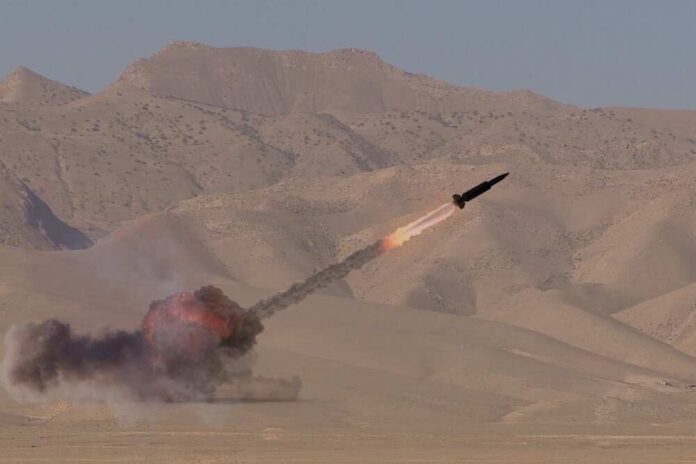
The U.S. Army’s Dark Eagle hypersonic missile — capable of striking targets at over five times the speed of sound — is edging toward its first-ever combat deployment as tensions with Iran intensify, and America’s adversaries are watching closely.
Story Highlights
- The Army fielded Dark Eagle to a multidomain task force in December 2025, marking initial operational capability after years of delays.
- U.S. Central Command has reportedly requested deployment of the system to the Middle East amid ongoing tensions with Iran.
- A $2.7 billion Leidos contract awarded in May 2026 is pushing the missile from testing into full-scale production.
- Questions remain about combat readiness, with a limited inventory of roughly eight missiles per battery and production running at approximately one missile per month.
Dark Eagle Reaches the Battlefield
The U.S. Army activated Bravo Battery, 1st Battalion, 17th Field Artillery at Joint Base Lewis-McChord on December 12, 2025, officially fielding the Dark Eagle Long-Range Hypersonic Weapon system to one of its multidomain task forces. The Army declared initial operational capability following years of testing, delays, and development hurdles. The system completed a successful end-to-end flight test at Space Launch Complex 46 at Cape Canaveral on December 12, 2024, clearing a critical milestone before fielding began.
The Dark Eagle system uses a Common Hypersonic Glide Body launched from a ground-based platform, capable of traveling at speeds exceeding Mach 5 and striking targets at ranges that leave adversaries minimal response time. Defense contractor Leidos received a $2.7 billion production contract in May 2026 to transition the Common Hypersonic Glide Body from testing into full manufacturing, signaling the Pentagon’s commitment to scaling up the program despite its rocky development history.
Iran Tensions Drive Deployment Debate
U.S. Central Command has reportedly requested deployment of the Dark Eagle system to the Middle East as military pressure on Iran has escalated. No deployment has been publicly confirmed, and Pentagon officials have not formally announced approval of the request. The potential deployment would mark the first operational use of a U.S. hypersonic weapon system in a real-world theater, a significant milestone that carries both military and strategic messaging implications for rivals like China and Russia watching from the sidelines.
Proponents argue the weapon’s speed and precision make it ideal for striking hardened or deeply buried Iranian facilities that conventional missiles cannot reliably reach. Iran has been expanding its ballistic missile and nuclear-related infrastructure into fortified underground sites, and the Dark Eagle’s glide-body design is specifically engineered to defeat advanced air defense systems that would intercept slower-moving conventional munitions.
Real Capability or Strategic Bluster?
Critics and some defense analysts have raised legitimate questions about the system’s combat readiness. The initial battery holds roughly eight missiles, with production running at approximately one missile per month — a limited stockpile for any sustained engagement. Some defense experts, including Jennifer Kavanagh of Defense Priorities, have questioned whether deploying the nation’s most advanced and expensive missiles against Iran represents sound strategic judgment, citing a unit cost estimated between $15 million and $41 million depending on accounting methodology.
U.S. Army Dark Eagle Hypersonic Missile Moves Toward Combat Deployment Under $2.7B Leidos Contract pic.twitter.com/RJnc0VHcUi
— Army Recognition (@ArmyRecognition) May 13, 2026
The Pentagon has also acknowledged that sufficient data to fully evaluate the missile’s combat effectiveness may not be available until early 2027, and the program experienced test failures and production quality issues earlier in 2024 before the December end-to-end success. These are real limitations worth acknowledging. However, the Army’s official initial operational capability declaration, the activation of a fielded battery, and a multibillion-dollar production contract are concrete institutional commitments — not paper announcements. For a nation facing a resurgent Iran, a nuclear-advancing adversary with proxies across the Middle East, having even a limited hypersonic strike capability in theater sends a message that no conventional weapon can replicate. The Trump administration’s willingness to develop and deploy cutting-edge military tools stands in sharp contrast to years of hollowed-out defense investment under previous leadership, and that matters when deterrence is the goal.
Sources:
[1] Web – Dark Eagle hypersonic weapon Middle East deployment … – Fox News
[2] YouTube – US Plans To Deploy Dark Eagle Hypersonic Missile Against Iran
[3] Web – Long-Range Hypersonic Weapon – Wikipedia
[4] Web – Dark Eagle Hypersonic Weapon Nears Deployment – Legis1
[5] Web – U.S. Army Dark Eagle Hypersonic Missile Moves Toward Combat …
[6] YouTube – U.S. Mulls Dark Eagle Deployment: Can It Target Iran’s …