Trump’s latest “law-and-order” budget pitch is igniting a familiar conservative dilemma: how to punish violent criminals without writing a blank check for another federal boondoggle.
Quick Take
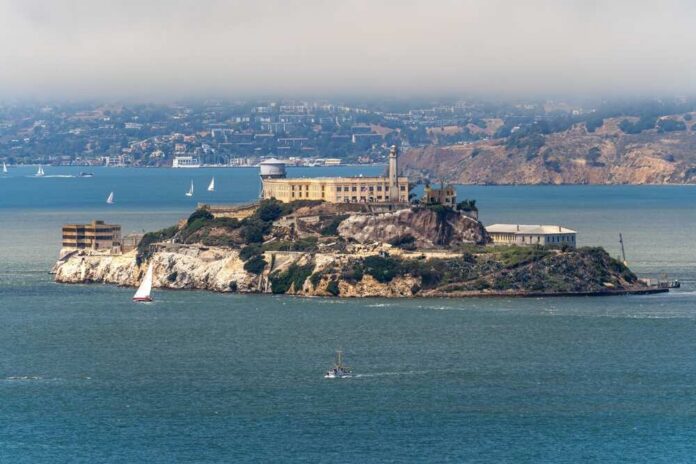
- President Trump’s FY2027 budget requests $152 million to begin rebuilding Alcatraz into a “state-of-the-art secure prison” for the most violent offenders.
- Multiple outlets report total costs could climb to around $2 billion or more, while Congress controls whether any funding actually happens.
- Alcatraz historically closed in 1963 because it was dramatically more expensive to operate than other federal prisons, and it now functions as a major National Park Service tourism site.
- Nancy Pelosi blasted the proposal as wasteful and political, while San Francisco leaders have argued there is no realistic plan beyond tourism.
What Trump’s budget actually requests—and what it doesn’t
The White House budget proposal for fiscal year 2027 asks Congress for $152 million to cover the first year of rebuilding Alcatraz Island into a modern high-security federal prison. The administration frames the concept as a way to house the nation’s “most ruthless and violent offenders,” tying the project to Trump’s long-running law-and-order messaging. The key limitation is simple: the request is only an opening tranche, not a full plan, timeline, or final cost.
Congress holds the power of the purse, so the proposal is not a done deal—especially with big ticket items competing for attention and an electorate that has grown skeptical of federal spending promises. Reporting on the proposal also underscores unresolved basics, including how a prison conversion would work on a decaying, saltwater-battered island with limited access. Even supportive voters who want tougher incarceration policies often demand to see firm numbers and a realistic buildout sequence.
Alcatraz’s history: a symbol of tough justice and a warning on costs
Alcatraz served as a federal prison from 1934 to 1963 and became famous for housing notorious criminals, including Al Capone. Its mystique has always been part of the point—and that symbolism is clearly central to the administration’s pitch. But the same history also carries an inconvenient fiscal lesson. The Bureau of Prisons has pointed to the prison’s extreme operating costs and deterioration as major reasons it shut down, with expenses reported as roughly triple other facilities.
After closure, Alcatraz shifted into a National Park Service tourism asset, generating substantial annual revenue and anchoring a large local tourism ecosystem. That reality is why Bay Area officials view the plan not just as a federal construction project, but as a direct threat to an existing economic engine and a nationally recognized historic site. Any conversion would force a policy choice: preserve a museum-like landmark that pays its way, or replace it with a costly, security-heavy facility that taxpayers fund indefinitely.
Pelosi’s backlash, local resistance, and what the fight is really about
Former House Speaker Nancy Pelosi publicly attacked the proposal as a “stupid notion” and a waste of taxpayer dollars, arguing Alcatraz should remain a public historic site rather than a political prop. San Francisco’s mayor has also criticized the concept, saying there was no realistic plan beyond tourism. The sharp rhetoric is predictable in a federal-versus-California showdown, but the substance is where conservatives should focus: the dispute centers on spending, feasibility, and whether symbolism is driving the decision more than outcomes.
Reporting indicates the administration’s idea traces back to a May 2025 Truth Social post directing federal agencies—BOP, DOJ, FBI, and DHS—to pursue reopening and enlargement. In July 2025, then-Attorney General Pam Bondi and Interior Secretary Doug Burgum visited the site, signaling the plan was more than a throwaway line. Even so, current coverage notes limited visible progress beyond the new budget request, leaving a gap between tough talk and operational readiness.
The conservative policy tension: safety, spending, and Congress’ constitutional role
Conservatives broadly support enforcing laws and separating violent offenders from the public, but the Alcatraz plan tests another core principle: limited, accountable government. A $152 million down payment can easily become a multi-year, multi-billion-dollar commitment, especially when the total has been described as potentially $2 billion or more. If the administration wants buy-in from fiscally cautious voters, Congress will need real estimates, oversight mechanisms, and clear benchmarks—not a headline-sized number that invites mission creep.
Congressional review will be the real checkpoint, because appropriations are where constitutional accountability either functions or fails. If lawmakers fund it, they own the cost curve, the procurement, and the long-term operating burden. If lawmakers reject it, the administration will need to explain how it will achieve the same public-safety goal through existing facilities and proven approaches. Either way, the debate is less about Pelosi’s outrage and more about whether Washington can deliver security without repeating the waste that helped close Alcatraz the first time.
Sources:
Alcatraz could reopen as a ‘state-of-the-art secure prison’ under Trump’s $152M budget request
Trump seeking $152 million from Congress to reopen Alcatraz as a federal prison
Trump asks for $152 million to rebuild Alcatraz and reopen it as a prison
Alcatraz, Trump budget, Congress
Alcatraz Trump budget defense spending